





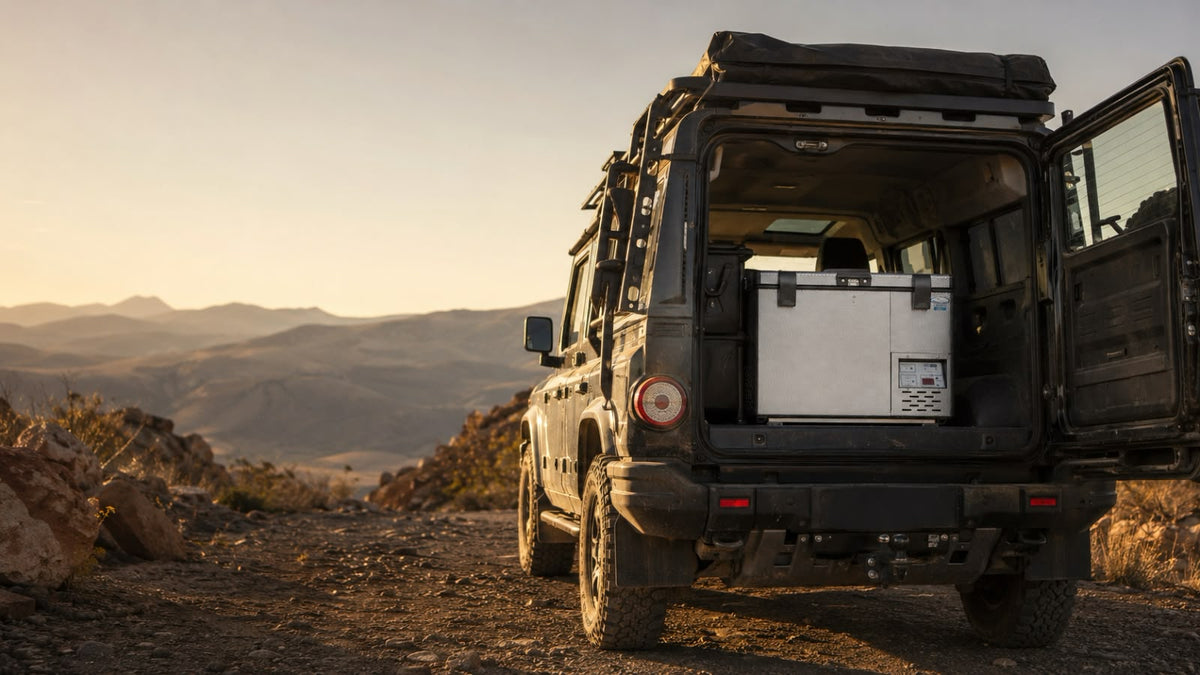
Power Station for Camping vs Dual Battery System for Overlanding
Every camping rig hits the same question: how do you keep a fridge cold and phones charged for a few days without killing the battery that starts the truck? There are two common answers. A portable power station is a self-contained battery box you carry and charge. A dual battery system is a second battery wired into the vehicle and charged by the alternator. This guide compares them, walks through sizing with real math, and covers the safety basics.
Short answer: A portable power station is the easier choice for weekend camping, renters and anyone who wants power away from the vehicle. It needs no install, but it charges slowly from a 12V socket. A dual battery system takes real install work, but it charges far faster while you drive, protects the starting battery automatically and suits a fridge running for days at a time. If you overland often with a 12V fridge, a dual battery system with a DC-DC charger is usually the better long-term setup.
What is a dual battery system?
A dual battery system adds a second, auxiliary battery to the vehicle, usually in the engine bay, bed or cargo area. The starting battery keeps starting the engine and running the factory electrics. Camp loads such as the fridge, lights and compressor run from the auxiliary battery. With the engine running, the alternator recharges both. With it off, the two are kept apart, so the fridge can drain the auxiliary battery and the truck still starts in the morning.
An isolator or a DC-DC charger manages that split.
Isolator vs DC-DC charger
- Isolator (voltage-sensing relay or solenoid): a heavy-duty switch that connects the two batteries when it senses charging voltage and disconnects them when the voltage drops after you shut off the engine. It is simple and robust, but the auxiliary battery only gets whatever voltage the alternator puts out. Many newer vehicles have smart or variable-voltage alternators that lower their output, so the battery may rarely reach full charge. A plain isolator also gives a lithium battery no charge profile of its own.
- DC-DC charger: an electronic charger that turns alternator power into a proper multi-stage charge. It can raise the voltage when the alternator runs low, limit current to a set rating, and use a profile matched to AGM, flooded or lithium. Many include an MPPT solar input. It adds cost and a part to mount, but it is the usual answer for smart alternators and for a lithium auxiliary battery next to a lead-acid starting battery.
As a real example, National Luna lists its NLDC-25 and NLDC-40 as dual battery isolators and chargers with true 25 A and 40 A output, built-in MPPT solar regulators, support for variable-voltage alternators, and charge profiles for AGM, gel, wet, calcium and lithium (LiFePO4) batteries. Genesis Offroad's OMEGA system for the 2016-2023 Tacoma pairs a steel tray and pre-wired lid with a Redarc 25 A DC-DC charger.
What is a portable power station?
A portable power station is a lithium battery, a charge controller, an inverter and a panel of outlets in one case. You charge it from a wall outlet, a solar panel or the vehicle's 12V socket, then plug in a fridge, laptop, phone or small AC appliance. Many newer units use LiFePO4 (LFP) cells, known for long cycle life.
There is nothing to install, it moves between vehicles, and it works at a picnic table as well as in the truck. The trade-offs show up on longer trips: a 12V socket can only deliver so much current, so car charging is slow, and larger units are heavy and eat cargo space.
Power station vs dual battery: side by side
| Factor | Portable power station | Dual battery system |
|---|---|---|
| Capacity | Fixed by the unit you buy, rated in watt-hours | Set by the battery you choose, rated in amp-hours; can be upgraded |
| Charging while driving | Slow; limited by the 12V socket and the unit's car input | Fast; a DC-DC charger delivers its full rated current from the alternator |
| Solar | Usually built in; plug a panel straight in | Needs a solar regulator; many DC-DC chargers include one |
| Portability | Moves between vehicles, home and camp | Stays with the vehicle |
| Install effort | None | Tray, cabling, fusing and charger; a few hours or a shop visit |
| Use outside the vehicle | Yes, anywhere you can carry it | Only within cable reach of the vehicle |
| Starting battery protection | Separate battery, but charging from a socket that stays live with the engine off can drain the starting battery | Handled by the isolator or charger |
| Space and weight | Takes cargo space and needs securing | Often uses dead space under the hood or a dedicated tray |
How to choose
A power station makes more sense if you camp a few weekends a year, drive a leased or shared vehicle, want backup power at home too, or need outlets away from the truck. It is also the honest answer if you would rather not touch your vehicle's wiring.
A dual battery system makes more sense if a fridge runs all trip, you drive most days between camps, you are already adding a compressor, lights and switch panel, or you want a system that looks after itself. Plenty of people run both: a dual battery system for the vehicle and a small portable battery for the tent or a Starlink Mini.
Sizing a system: a worked example
Size from your loads, not the biggest number on the shelf. The numbers below are example figures for illustration only, not specs for any product. Check your own fridge's documentation or measure with a battery monitor.
Step 1: fridge draw. A 12V compressor fridge cycles on and off, so what matters is the average. Say the compressor pulls 4 A while running and runs 40% of the time in warm weather.
4 A × 0.40 = 1.6 A average. 1.6 A × 24 hours = 38.4 Ah per day.
Step 2: everything else. Add a 1 A LED camp light for 4 hours (4 Ah) and about 3 Ah for phone charging. The daily total is 38.4 + 4 + 3 = about 45 Ah per day.
Step 3: days without charging. If you want to sit in one camp for two days without driving: 45 Ah × 2 = about 90 Ah that must be usable.
Step 4: battery chemistry. Not all rated capacity is usable. As a general rule, lead-acid batteries, including AGM, last much longer if kept above about 50% charge. Lithium iron phosphate (LiFePO4) batteries can routinely use 80% or more of their rating.
- Lead-acid or AGM: 90 Ah ÷ 0.5 = about 180 Ah rated.
- Lithium at 80% usable: 90 Ah ÷ 0.8 = about 113 Ah rated.
Step 5: the power station version. Power stations are rated in watt-hours (Wh = Ah × volts). At a nominal 12.8 V, 90 Ah is about 1,160 Wh. Power stations lose some energy converting to their 12V and AC outputs, so allow 10 to 15% extra. At 15%, you are shopping for roughly 1,370 Wh of capacity.
Step 6: getting it back. A 25 A DC-DC charger can put back up to about 25 Ah per hour of driving, so a day's 45 Ah takes a little under two hours if the battery accepts full current. Lithium generally does; AGM tapers as it fills. A power station that accepts, say, 120 W from a 12V socket needs nearly five hours to replace the same day (45 Ah × 12.8 V = 581 Wh). That charging gap is the biggest practical difference between the two setups.
Solar basics
Solar extends your stay; it rarely replaces vehicle charging on its own. A panel's watt rating is its output under ideal test conditions, and real output depends on season, weather, angle and shade. For planning, multiply rated watts by local peak sun hours and a derate of about 75% for heat, wiring and controller losses.
Using example numbers: 100 W × 4 peak sun hours × 0.75 = 300 Wh, or about 23 Ah at 12.8 V, half of our 45 Ah day. A 200 W setup makes about 47 Ah and roughly breaks even on a sunny day.
- Use a charge controller. Panels connect to a battery through a regulator. MPPT controllers generally harvest more than PWM types. Power stations and many DC-DC chargers include one.
- Portable panels vs fixed panels. A folding panel can sit in the sun while the truck stays in the shade. A roof-mounted panel charges whenever there is light.
- Match voltage limits. Keep the panel's open-circuit voltage under the controller's maximum input; National Luna lists 42 V for its NLDC chargers.
Safety and install basics
- Fuse every positive cable near the battery. A cable between two batteries needs a fuse at both ends, because either battery can feed a short. Size fuses and cable to the charger maker's instructions.
- Use the right cable and terminals. Undersized cable runs hot and wastes voltage. Crimp lugs properly and route cable away from sharp edges and exhaust heat.
- Ventilate flooded lead-acid batteries. They can release hydrogen gas while charging, so they do not belong in a closed cabin or box without proper venting. Sealed AGM batteries are more forgiving, but still follow the battery maker's guidance.
- Respect lithium's limits. Use a lithium battery with a built-in battery management system and a charger with a lithium profile. LiFePO4 generally should not be charged below freezing unless the battery has low-temperature protection or a heater. Under-hood heat is another concern; Genesis Offroad says it is not aware of a Group 34 lithium battery that can withstand under-hood temperatures.
- Secure everything. Use a proper tray or hold-down, and strap portable units in.
- Follow the manufacturer's instructions. If the wiring is outside your comfort zone, use a qualified shop.
Common mistakes to avoid
- Forgetting lead-acid's usable capacity. A 100 Ah AGM is closer to a 50 Ah battery for regular use.
- Expecting a 12V socket to refill a big power station quickly.
- Using a plain isolator with a smart alternator or lithium battery. A DC-DC charger is usually the right part.
- Mixing up battery shut-off switches and charging isolators. A manual disconnect switch cuts power; it does not manage charging.
- Skipping a monitor. A battery monitor warns you before the fridge warms up.
What NVMOS carries
For installed systems, NVMOS carries Genesis Offroad dual battery kits, National Luna DC-DC chargers and monitors, and trays and mounting platforms from PowerTrays, Rago Fabrication, C4 Fabrication and Colorado & Canyon Enthusiasts. For portable power and solar, look at Devos Outdoor and KC HiLiTES.
- Genesis Offroad 2016-2023 Toyota Tacoma OMEGA Dual Battery System
- Genesis Offroad 2021+ Ford Bronco OMEGA Dual Battery System
- CCE Dual Battery Tray with Redarc Charger and Wire Harness, 2015-2022 Colorado/Canyon
- National Luna NLDC-25 DC-DC 25 Amp Charger
- National Luna NLDC-40 DC-DC 40 Amp Charger
- National Luna Battery Monitor
- Rago Fabrication The Surge for the 5th Gen 4Runner
- C4 Fabrication 4Runner Spare Battery Tray, Passenger Side (5th Gen)
- PowerTrays Dual Powerswitch PowerTray for Tacoma TRD Off Road/Pro
- Devos Outdoor AMPak 145 Portable Battery for the Starlink Mini
- Devos Outdoor 105 Watt Bi-Folding Solar Panel
- KC HiLiTES 150W Portable Foldable Solar Panel
Browse by category: Dual Battery Kits, Battery Trays, Battery Accessories, Power Pack Systems, Camp Power Solutions and Fridges. You can also shop by vehicle, check current lead times and read the vendor warranty policies.
Shop dual battery kits → Shop camp power →
Frequently asked questions
Is a power station or a dual battery system better for camping?
For occasional weekend trips, a power station is simpler because it needs no install and works anywhere. For frequent trips with a 12V fridge, a dual battery system usually wins because it recharges much faster while you drive and manages itself.
What size power station do I need to run a 12V fridge?
Multiply the fridge's daily amp-hours by the days between charges, convert to watt-hours at about 12.8 V and add 10 to 15% for losses. In our example, about 45 Ah a day for two days called for roughly 1,370 Wh.
How does a dual battery system work in a truck?
The alternator charges both batteries while the engine runs. When it stops, an isolator or DC-DC charger separates them, so camp loads drain only the auxiliary battery and the starting battery stays ready to start the engine.
Do I need a DC-DC charger or an isolator?
A DC-DC charger is the safer bet if your vehicle has a smart or variable-voltage alternator, or if the auxiliary battery is lithium or a different type than the starting battery. A simple isolator can work when both batteries are the same lead-acid type and the alternator holds a steady charging voltage.
Can I charge a power station from my car while driving?
Yes, through the 12V socket, but slowly. The socket's fuse and the station's car input rating limit charging power, so a large unit can take many hours of driving to refill.
Can I put a lithium battery under the hood?
Be cautious. Engine bay heat is hard on batteries, and lithium has temperature limits. Genesis Offroad says it is not aware of a Group 34 lithium battery that can withstand under-hood temperatures. Check the battery maker's ratings first.
How much solar do I need for overlanding?
Plan from your daily use. As a rough estimate, rated watts × peak sun hours × 0.75 gives daily watt-hours. With 4 sun hours, 100 W makes about 23 Ah a day and 200 W about 47 Ah, enough to roughly offset a fridge, lights and phones on a sunny day.
How long will a 100Ah battery run a fridge?
It depends on the fridge, weather and battery type. With our example fridge at 38.4 Ah a day, a 100 Ah lithium battery with 80 Ah usable would last about two days, while a 100 Ah AGM kept above 50% would last a little over one day.
Not sure which charger, tray or battery fits your rig? Call a real person at (920) 249-7744 or send us a message, and we will help you work it out.
