





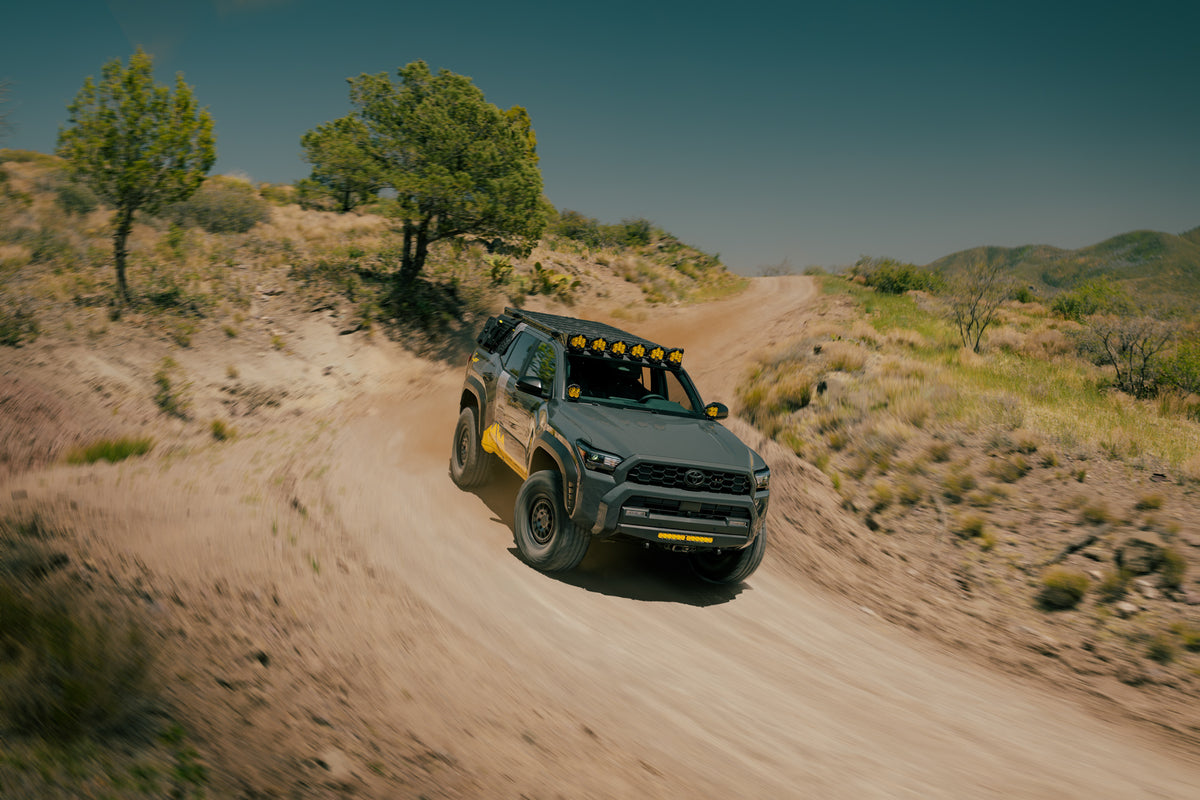
Toyota 4Runner Overland Build Guide: What to Upgrade, in Order
Plenty of 4Runner builds start with lights and a roof rack, add a lift, and only then discover the truck still rides on highway tires, has nothing rated to pull from, and is near its weight limit before the first camping trip. This guide puts an overland build in a sensible order, explains what each phase costs in weight and trade-offs, and covers the parts differences between the 5th gen (2010–2024) and the 6th gen (2025 and newer).
Short answer: Build a 4Runner for overlanding in this order: tires and recovery gear first, then underbody armor and rock sliders, then suspension (a leveling kit or a modest lift matched to your tire size), then lighting, roof rack and storage, power and onboard air, and finally interior drawers. Check your door-jamb placard for payload before every phase, and confirm every part by model year, trim and powertrain, because 5th-gen and 6th-gen parts don't interchange.
What does "overland build" actually mean?
Overlanding is self-reliant travel over mixed terrain, usually camping out of the vehicle for several days. It isn't rock crawling. An overland 4Runner needs to be reliable, carry a load, get itself unstuck and stay comfortable on long washboard roads. It doesn't need the biggest tires or the most articulation, and every part has to earn its weight, because payload on a midsize SUV runs out quickly.
Know your generation, trim and powertrain first
Almost nothing structural carries over between generations. The 5th gen covers 2010–2024, with many front-end parts listed separately for 2010–2013 and 2014–2024. The 6th gen starts with the 2025 model year, with gas and hybrid powertrains. Trim matters within each:
- Trim matters on the 5th gen. C4 Fabrication says its 2014–2024 4Runner sliders don't fit Limited models or 2022 Sport models.
- Suspension on the 5th gen. Some trucks have KDSS or X-REAS, which changes which lift kits fit.
- Trim on the 6th gen. ReadyLIFT's 3 inch SST2.1 system for the 2025 4Runner excludes TRD Pro and Trailhunter models.
- Hybrid vs gas on the 6th gen. Goose Gear lists separate Hybrid and Non Hybrid versions of its rear plate system.
Write down your model year, trim, drivetrain (2WD or 4WD) and powertrain, and match all four against the product title and fitment notes. If you're unsure, call us with your VIN.
The build in order: phases at a glance
| Phase | What it covers | Why it comes here | Main trade-off |
|---|---|---|---|
| 1. Tires, wheels, recovery | All-terrain tires, full-size spare, recovery points and kit | Grip, puncture resistance and getting home | Bigger tires add weight and change gearing |
| 2. Armor | Skid plates, rock sliders, optionally a bumper | Protects the parts that end trips | Steel is heavy and eats payload |
| 3. Suspension | Leveling kit or lift, shocks, track bar correction | Springs should suit the real loaded weight | Geometry changes, alignment needed |
| 4. Lighting | Fog replacements, ditch lights, light bars, wiring | Useful once the truck can get unstuck | Check your state's rules |
| 5. Roof rack and storage | Roof rack, ladder, MOLLE panels | Moves bulky gear out of the cabin | Raises the center of gravity |
| 6. Power and air | Dual battery, power distribution, onboard compressor | Runs a fridge, airs tires back up | Engine-bay space, install time |
| 7. Interior | Drawers, plate systems, sleep platforms | Organizes a load you now understand | Drawers are heavy and eat cargo height |
Phase 1: Tires, wheels and recovery
Tires come first. Most overlanders choose an all-terrain tire in light-truck (LT) construction for tougher sidewalls. Match or exceed the load rating on the original tires, and carry a matching full-size spare.
Size is where the trade-offs start. A tire's diameter in inches is roughly the rim size plus twice the sidewall height: diameter = rim + 2 × (width in mm × aspect ratio as a decimal ÷ 25.4). A 285/70R17 works out to about 32.7 inches, a 285/75R17 to about 33.8, and a 315/70R17 to about 34.4. Bigger tires gain a little clearance but weigh more, slow acceleration and braking, and throw off the speedometer. If you go from a 31 inch to a 33 inch tire, your actual speed is about 6.5 percent higher than the speedometer shows (33 ÷ 31 = 1.065), so an indicated 60 mph is really about 64.
Recovery gear belongs here, not after the lights. A basic kit is rated recovery points, a soft shackle or rated D-ring, a kinetic or static recovery strap, traction boards, a shovel, a tire deflator and a way to air back up. On the 6th gen, SXTH Element makes billet front recovery points for the 2025 and newer 4Runner and recommends using a bridle with them so the load is spread across both points. Use rated gear, never attach to a tow ball or suspension part, and follow the manufacturer's instructions.
Phase 2: Armor, sliders and skid plates
Once the truck goes farther, it finds rocks. Armor in rough order of usefulness:
- Skid plates for the front, transmission and transfer case. Cali Raised LED offers its 5th-gen transfer skid in 3/16 inch steel at 35 lb or 1/4 inch aluminum at 20.5 lb, which shows the steel-versus-aluminum weight trade.
- Rock sliders, frame-mounted, to protect the rockers. C4's 2014–2024 sliders weigh 65 lb each with step plates. Cali Raised LED's Trail Edition sliders for the 2025 and newer 4Runner are about 100 lb a set, and the brand lists them as fitting every 6th-gen trim, hybrid included.
- A steel front bumper, only if you need winch mounting or more approach angle. It's often one of the heaviest single parts in a build.
Phase 3: Suspension, leveling kits, lifts and KDSS
A leveling kit raises the front to match the rear. A lift raises the whole truck, usually with new coilovers, rear springs and shocks. For most overland 4Runners, a modest lift with springs that suit the loaded weight is the right answer, which is why it comes after armor and the heavy gear.
KDSS on the 5th gen. KDSS (Kinetic Dynamic Suspension System) is Toyota's hydraulically linked sway bar system, as Dr. KDSS describes it, and it was fitted to some 4th- and 5th-gen 4Runners. It narrows your lift choices. ReadyLIFT says its 3 inch SST2.1 system for the 2010–2024 4Runner will not work on KDSS or X-REAS trucks or on the TRD Pro. Other makers differ; ICON says its systems work on KDSS-equipped 2003–2009 4Runners with its adjustable rear track bar. Read each listing for your year.
Track bar correction. When you lift a 4Runner, the rear track bar angle changes and pulls the rear axle off center. Dr. KDSS makes bolt-on track bar correction kits for several 4Runner generations, including the 6th gen, and ICON makes adjustable rear track bars for both the 2003–2024 and the 2025 and newer trucks.
6th-gen options. ReadyLIFT's front leveling kit gives the 2025–2026 4Runner 1 inch of front lift and lists clearance for a 285/70R17 without trimming. The brand notes it hasn't tested the kit on TRD Pro, AVS or hybrid models. Its 3 inch SST2.1 system is listed for up to 285/75R17 on an 8 inch wide +35 offset wheel without trimming, but it excludes TRD Pro and Trailhunter models.
Big tires on the 5th gen. C4's oversized tire fitment kit is designed for 35 inch tires on a 3 inch lift. It requires cutting the fenders and cutting out the factory body mount to weld in a replacement, so it's a commitment.
Expect an alignment after any lift. ReadyLIFT also notes that headlamp adjustment and ADAS recalibration may be needed after installing its 5th-gen system.
Phase 4: Lighting
Good lighting helps with late arrivals and dusty roads. Start with fog and ditch lights, then add a light bar if you drive off-road at night a lot. On the 6th gen, Baja Designs' upfitter harness connects lights to the factory upfitter switches, and the brand says it supports up to four Baja Designs light kits. Rules on using auxiliary lights on public roads vary, so check your state's rules before you wire them.
Phase 5: Roof racks and storage
A flat roof rack carries traction boards, an awning or a rooftop tent. C4's 4Runner racks for both generations are aluminum, bolt to factory mounting points, and work with the sunroof, according to the brand. Rago Fabrication's 6th-gen rack is also aluminum and fully bolt-on.
Roof weight raises the center of gravity, which matters off-camber. Check the rack maker's load rating and the roof limit in your owner's manual, and use the lower one. A static rating (parked, like an occupied tent) differs from a dynamic rating (while driving). Many rack pages don't list ratings, so ask the brand before you mount a tent.
Phase 6: Power and onboard air
A fridge will flatten a starting battery. A dual-battery system keeps the starter battery separate. Genesis Offroad's dual-battery system for the 2010–2024 4Runner uses a smart combiner rated at 300 amps continuous and requires matching Group 25 batteries; the factory battery isn't compatible. A portable power station is the simpler alternative.
Onboard air lets you air down for traction and air back up for the highway. On the 6th gen, Rago Fabrication's under-hood mount for ARB twin compressors fits both gas and hybrid models, according to Rago.
Phase 7: Interior, drawers and sleeping
Drawers keep gear organized and secure, but they're heavy and take cargo height. Trail Grid Pro's 5th-gen drawers weigh 80 lb for the 8 inch version and 88 lb for the 12 inch. On the 6th gen, Goose Gear offers plate systems, seat deletes and a Stealth Sleep package, listed separately for hybrid and non-hybrid trucks. To get smaller gear off the floor, rear window MOLLE panels are a common 4Runner upgrade, covered in our MOLLE panels guide. Do this last, once you know what you carry.
Weight and payload: check your door placard
Your 4Runner's Tire and Loading Information placard, normally on the driver's side B-pillar, states the most combined weight of occupants and cargo the vehicle should carry. That's your budget for people, gear and every part in this guide.
Remaining capacity = placard figure − occupants − cargo − added parts
A pair of C4 5th-gen sliders (130 lb), an 8 inch Trail Grid Pro drawer (80 lb) and a steel Cali Raised transfer skid (35 lb) already total 245 lb before bumpers, racks, fuel, water or people. Heavier tires and wheels count too, and the extra rotating weight also affects braking and acceleration.
Mistakes to avoid
- Buying a lift before tires and recovery gear. A lift without the right tires is mostly looks.
- Ignoring KDSS, X-REAS or trim. Some kits exclude KDSS, TRD Pro or Trailhunter trucks. Confirm before you order.
- Mixing up generations. A 2010–2024 part won't fit a 2025 truck. Confirm by year, trim and powertrain.
- Ignoring payload. Add up the weight before you buy, not after.
- Improvised recovery. Use rated recovery points and gear and follow the instructions.
What NVMOS carries
For 4Runner builds we stock C4 Fabrication, Cali Raised LED, ReadyLIFT, ICON Vehicle Dynamics, Dr. KDSS, Rago Fabrication, SXTH Element, Genesis Offroad, Baja Designs, Trail Grid Pro, Goose Gear and TufSkinz. Representative parts by generation:
5th gen (2010–2024)
- C4 Fabrication 4Runner Rock Sliders, 5th Gen, 2014–2024
- Cali Raised LED Complete Skid Plate Collection for 2010–2024 4Runner
- C4 Fabrication 4Runner Oversized Tire Fitment Kit, 5th Gen
- C4 Fabrication 4Runner Roof Rack with Optional Light Bar Mount, 5th Gen
- Genesis Offroad 2010–2024 Toyota 4Runner Gen 3 Dual Battery System
- Trail Grid Pro Toyota 4Runner Drawer System, 2010–2024
6th gen (2025 and newer)
- SXTH Element Front Recovery Points for 2024+ Tacoma, 4Runner and Land Cruiser
- Cali Raised LED Trail Edition Rock Sliders for 2025+ 4Runner
- ReadyLIFT Front Leveling Kit, 1 inch for 2025–2026 4Runner
- ReadyLIFT 3 inch SST Lift Kit for 2025 4Runner
- C4 Fabrication 4Runner Roof Rack with Optional Light Bar Mount, 6th Gen
- Rago Fabrication 2025+ 4Runner Under-Hood Air Compressor Mount
Browse everything for the Toyota 4Runner, compare 4Runner lift kits, see Goose Gear for the 4Runner and TufSkinz 4Runner accessories, and start phase one with wheels and tires and recovery kits. See every brand we carry, check current lead times. In-stock parts ship in 24 to 48 hours.
Shop 4Runner parts → Shop 4Runner lift kits →
Frequently asked questions
What should I upgrade first on a 4Runner for overlanding?
Tires and recovery gear. All-terrain LT tires, a full-size spare, rated recovery points, a strap and traction boards do more for an overland trip than lights or a lift. Armor comes next, then suspension.
Do I need a lift kit to overland in a 4Runner?
No. A stock or leveled 4Runner on good all-terrain tires handles most overland routes. A modest lift helps when you want bigger tires or springs that suit a heavier loaded weight.
What is KDSS and does it affect lift kits?
KDSS is Toyota's Kinetic Dynamic Suspension System, a hydraulically linked sway bar system fitted to some 4th- and 5th-gen 4Runners. Some lift kits don't fit KDSS trucks. ReadyLIFT's 3 inch SST2.1 system for 2010–2024 4Runners, for example, won't work with KDSS or X-REAS.
Do 5th gen 4Runner parts fit a 2025 4Runner?
Generally no. Armor, racks, suspension and interior parts are generation-specific. Confirm every part by year, trim and powertrain.
What size tires fit a 6th gen 4Runner with a leveling kit?
It depends on the kit. ReadyLIFT lists 285/70R17 without trimming for its 1 inch front leveling kit on the 2025–2026 4Runner, and up to 285/75R17 on an 8 inch wide +35 offset wheel for its 3 inch SST2.1 system.
How much weight can a 4Runner carry?
Check the Tire and Loading Information placard on the driver's side B-pillar. It lists the most combined weight of occupants and cargo your truck should carry. Subtract passengers, gear and added parts from it.
Can I use hybrid 4Runner parts on a gas 4Runner?
Not always. Some 6th-gen parts are listed separately for hybrid and non-hybrid trucks, such as Goose Gear's rear plate systems. Others, like Rago Fabrication's compressor mount, fit both. Check the listing for your powertrain.
Planning a 4Runner build and not sure what fits your year and trim? Call a real person at (920) 249-7744 or reach us through our contact page.
