





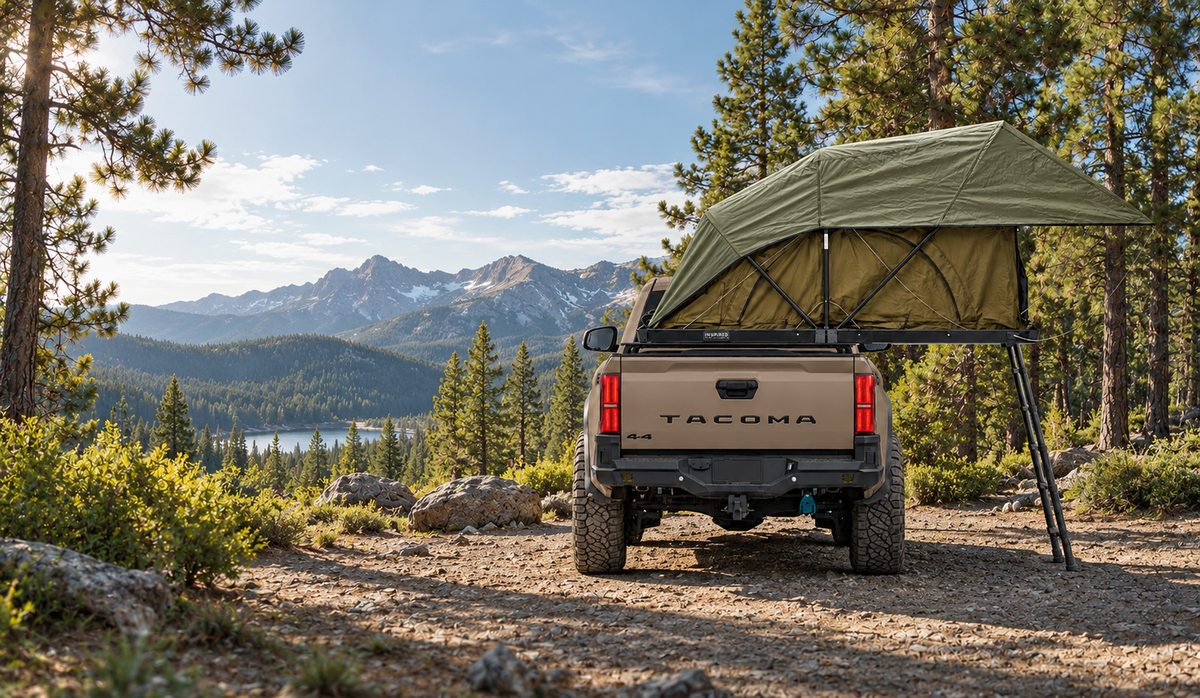
Toyota Tacoma Overland Build Guide: What to Buy, in Order
Most Tacoma overland builds go wrong the same way: parts go on in the order they look good, not the order that makes the truck more capable. This guide lays out a phased build, from tires and recovery gear through armor, suspension, lighting, racks, power and interior storage, explains why each phase sits where it does, and covers what changes between the 2nd, 3rd and 4th generation trucks. Building a Ford instead? See our Ford Ranger overland build guide.
Short answer: Build a Tacoma for overlanding in this order: tires, wheels and recovery gear first; then armor such as sliders, skid plates and bumpers; then suspension sized for the finished weight; then lighting; then bed or roof racks; then power and onboard air; then interior storage. Check the payload figure on your door placard before every phase, because each part eats into it. Parts are generation-specific, so confirm year, cab, bed and trim before you buy.
Know your Tacoma generation first
Before you shop, know your model year, cab, bed length and trim.
- 2nd gen (2005–2015). A lot of frame-mounted armor is listed for 2005–2023, but lights and trim are often 2nd-gen only. ICON notes that its 2005–2023 Stage 1 EXP kit doesn't fit 2005–2015 rear-wheel-drive Tacomas with five-lug wheels, so even one generation isn't uniform.
- 3rd gen (2016–2023). Shares much underbody fitment with the 2nd gen; lighting, interior and electrical parts usually differ. Some narrow further, like a CBI compressor mount listed for 2016–2019 only.
- 4th gen (2024+). A clean break. Toyota built it on the TNGA-F platform shared with the Tundra, Sequoia and Land Cruiser, with a coil-spring multilink rear on most grades. Leaf springs stay on the SR, SR5 XtraCab and TRD PreRunner. Engines are the 2.4-liter turbo i-FORCE or the i-FORCE MAX hybrid, and Toyota offers a Double Cab with a 5 or 6 ft bed or an XtraCab with a 6 ft bed.
Trim matters as much as year. ICON's Stage 1 EXP kit excludes the TRD Pro. ReadyLIFT's 3 inch kit for the 4th gen excludes leaf-spring trucks, the TRD Pro, the Trailhunter and trucks with Adaptive Variable Suspension. DV8's 4th-gen rock sliders fit 4-door models only and not the 6 ft bed. Read every fitment note against your exact truck.
Payload, GVWR and the door placard
Every part adds weight. Two labels on the driver's door jamb set the limits:
- The Tire and Loading Information placard states the most that occupants and cargo together should weigh. Federal rules require the wording "The combined weight of occupants and cargo should never exceed" a set number of pounds.
- The certification label lists the GVWR, the most the fully loaded truck may weigh.
Payload varies by cab, bed, drivetrain and trim, so read your own placard and do the math with every part:
Remaining capacity = placard figure − occupants − cargo − added accessories
As an example, if a placard said 1,100 lb, two adults at 180 lb each (360 lb), a pair of C4 sliders at 75 lb each (150 lb) and 250 lb of camping gear, water and recovery kit would leave 1,100 − 360 − 150 − 250 = 340 lb for everything else: bumpers, a winch, racks and fuel. Water alone is about 8.3 lb a gallon, so a 10 gallon supply is about 83 lb. Weigh the loaded truck on a public scale and compare it to the GVWR.
The build order at a glance
| Phase | What it covers | Why it goes here | Weight impact |
|---|---|---|---|
| 1. Tires, wheels, recovery | All-terrain LT tires, wheels, traction boards, rated recovery points, deflators | Tires do the most for traction; recovery gear gets you home | Low to moderate |
| 2. Armor | Rock sliders, skid plates, bumpers, winch | Protects the truck and sets most of the added weight | High |
| 3. Suspension | Leveling kit, lift, shocks, springs, control arms | Springs should be chosen for the finished weight | Low |
| 4. Lighting | Ditch lights, fog replacements, light bars, wiring | Useful, but not before the truck can get unstuck | Low |
| 5. Racks and storage | Roof racks, bed racks, cab racks, MOLLE panels | Plan once you know how much payload is left | Moderate to high |
| 6. Power and air | Dual battery, power station, onboard compressor | Supports fridges, lights and airing back up | Moderate |
| 7. Interior | Seat deletes, drawers, console storage, device mounts | Organizes the gear you've proven you need | Low to moderate |
Phase 1: Tires, wheels and recovery gear
Tires touch the trail, so they come first. A good all-terrain tire in an LT (light truck) construction resists sidewall punctures better than a passenger tire and handles a loaded truck better. Make sure the replacement tire's load rating meets or exceeds the original spec.
Taller tires are the only part that raises the axles and differentials; a lift raises the body and frame. They also add rotating weight, change gearing and throw off the speedometer:
Actual speed = indicated speed × (new tire diameter ÷ old tire diameter)
For example, going from a 265/70R16 (about 30.6 inches tall) to a 285/70R17 (about 32.7 inches) gives a ratio of about 1.069, so an indicated 60 mph is about 64 mph. Diameter is the rim size plus twice the sidewall height (width × aspect ratio, converted to inches). Some sizes need trimming: ICON lists 33x11.50 tires with its 0–2 inch Tacoma kit and says minor fender trimming may be required, and C4 makes oversized tire fitment kits and high-clearance fender liners for the 3rd gen. Confirm bolt pattern, offset and load rating for your year before you buy wheels.
Then the recovery kit: traction boards, a deflator and gauge, a kinetic rope or strap, rated shackles, gloves and a shovel. Use only rated recovery points, never a tow ball, and follow each maker's instructions. DV8's 4th-gen D-ring mounts take standard 3/4 inch D-rings with a 7/8 inch pin, which aren't included. DV8 recommends using your hitch for severe recoveries, and the mounts don't fit TRD Pro or Trailhunter trucks with the factory ARB rear bumper.
Phase 2: Armor, sliders and skid plates
Armor comes before suspension for one practical reason: it's where most of the build's weight lands, and springs should be chosen for the weight they'll actually carry. A steel front bumper and winch put a lot of mass ahead of the front axle, and the right spring rate depends on whether that's there.
- Rock sliders protect the rockers and are the first armor most Tacomas need. C4's 2005–2023 sliders fit the Access Cab long bed and Double Cab short bed, are 100% bolt-on and weigh 75 lb each. DV8's 2024–2026 sliders use 4mm steel and quote about a two-hour bolt-on install.
- Skid plates cover the front end, transmission, transfer case and fuel tank. Steel resists damage better; aluminum saves weight.
- Bumpers and a winch are the heaviest single upgrade. Buy them when you know you need them.
Phase 3: Suspension, leveling or lift
A leveling kit raises the front to remove factory rake. It's simple, but on independent front suspension, extending the strut increases CV and ball joint angles, and it does nothing for a loaded rear. A suspension lift replaces shocks, struts or springs and often the upper control arms. A matched front-and-rear complete system suits a heavy overland truck best.
ICON's Stage 1 EXP for 2005–2023 gives 0–2 inches of front lift and 0–1.5 inches of rear lift with 2.5 front coilovers, a sway bar relocation kit and 2.0 rear shocks. ReadyLIFT's 3 inch SST2.1 for the 4th gen includes Falcon 2.1 struts and shocks, upper control arms, skid plates, differential drop parts and bump stop extensions. ReadyLIFT estimates six hours, plus or minus an hour, excluding alignment, and recommends a certified mechanic. Get an alignment after any suspension work.
Phase 4: Lighting
Lighting is easy to overdo and easy to wire badly. Start with ditch lights and better fogs. Brackets are generation-specific. Morimoto sells separate 2Banger ditch light systems for 2005–2015 and 2016–2023 Tacomas, and states that its Spot and Combo patterns comply with SAE J581 for an auxiliary high beam when aimed properly. On a 4th gen, Baja Designs makes an upfitter harness and OEM fog replacement kits for the 2024–2026 Pro and Trailhunter. Use relays and fuses, and check your state's rules on off-road lights before using them on the road.
Phase 5: Bed and roof storage
A loaded rack raises the center of gravity, so put heavy items low in the bed and keep roof loads light. The options:
- Roof racks carry light, bulky gear. C4's 4th-gen rack is aluminum, bolts to factory mounting points, sits about a quarter inch above the factory antenna and takes about 45 minutes with two or three people.
- Bed racks carry a rooftop tent or awning over the bed and keep the cab roof clear.
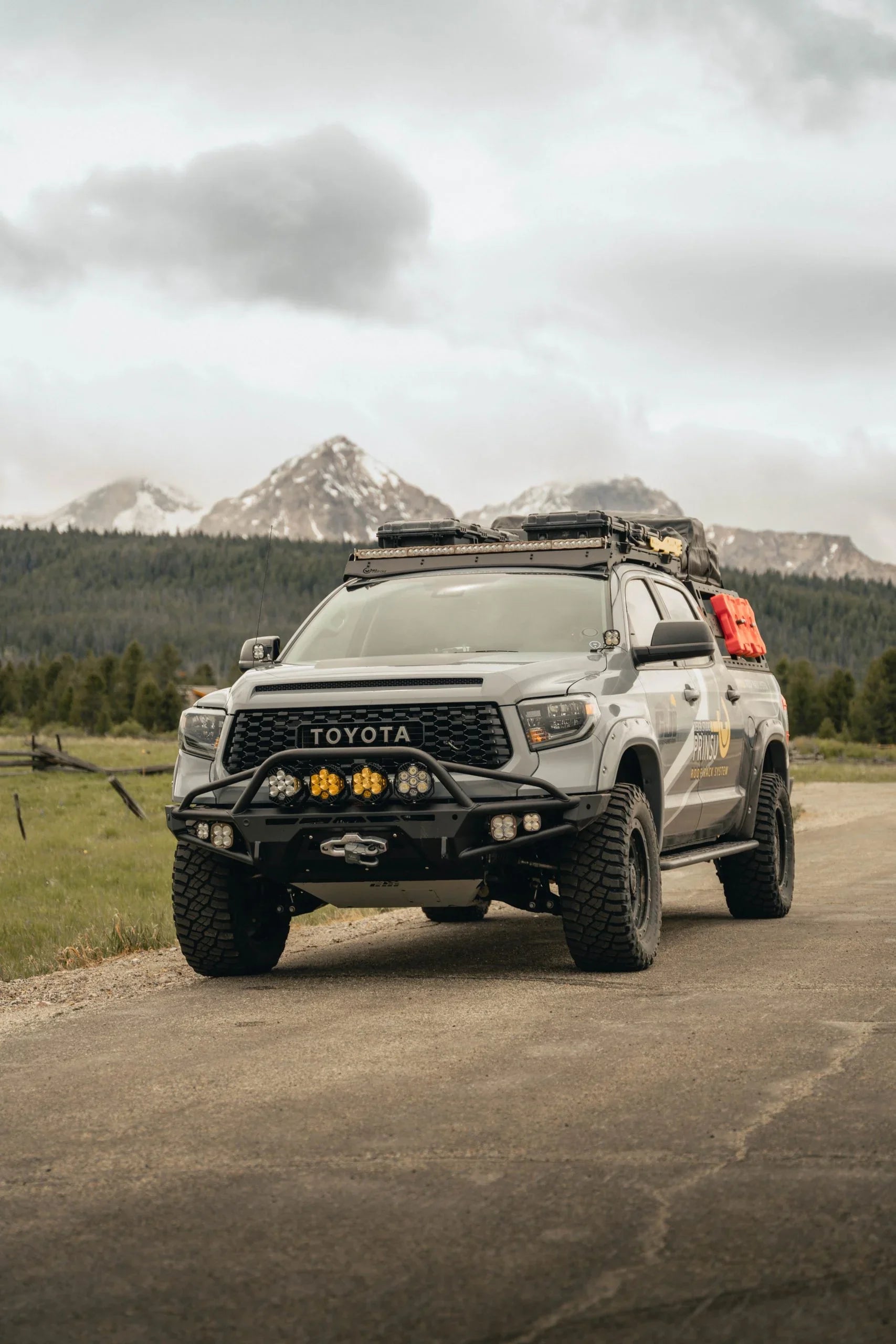
- Cab racks such as the Prinsu Pro for 2005–2023 work with the factory desert air intake, per the product title.
Not every maker lists a load rating. Ask for the dynamic rating, which applies while driving, and compare it to the roof load limit in your owner's manual. The lower number wins.
Phase 6: Power and air
A fridge needs power that won't drain the starting battery. A dual battery system adds a second battery charged by the alternator. Genesis Offroad's OMEGA system for 2016–2023 Tacomas puts both batteries in the engine bay on a steel tray, with a Redarc Alpha 25 amp DC-DC charger. Genesis specifies Group 34 batteries and says it isn't aware of a Group 34 lithium battery that can handle under-hood heat. A portable power station is the simpler choice if your loads are small.
Onboard air lets you air down for the trail and back up before the highway. Compressor mounts are generation-specific, and sometimes year-specific within a generation.
Phase 7: Interior and organization
Interior storage comes last, once you know what you carry. Seat delete systems turn a Double Cab rear seat into secure storage: Goose Gear lists one for 2005–2023 Double Cabs, and SXTH Element makes a rear seat delete MOLLE kit for the 2024+ truck. Device mounts are generation-specific down to the screen size. Tackform's 2024+ dash clips are listed for the 8 and 14 inch screens, and some 4th-gen interior parts are listed for non-hybrid trucks only.
Mistakes to avoid
- Buying a lift before tires. The lift raises the body. Tires raise the axles and give you the traction.
- Overloading. Adding parts until the truck is over its placard figure. Weigh it.
- Choosing springs before armor. Springs chosen for a stock-weight truck sag under a bumper, winch and drawers.
- Ignoring trim exclusions. TRD Pro, Trailhunter, leaf-spring 4th gens and AVS trucks are excluded from many kits.
- Using unrated recovery points. Never recover from a tow ball or tie-down loop.
What NVMOS carries
We stock Tacoma parts for every phase from C4 Fabrication, DV8 Offroad, CBI Offroad Fab, Addictive Desert Designs, ICON Vehicle Dynamics, ReadyLIFT, Morimoto, Baja Designs, KC HiLiTES, Prinsu Design Studio, Rago Fabrication, Genesis Offroad, Goose Gear, SXTH Element and TufSkinz. A few representative parts, by generation:
- DV8 Offroad D-Ring Recovery Mounts, 2024–2026 Tacoma
- Rago Fabrication Bed Rail Recovery Board Mounts, Tacoma and Tundra
- C4 Fabrication Tacoma Rock Sliders, 2nd and 3rd Gen, 2005–2023
- DV8 Offroad Double Cab Rock Sliders, 2024–2026 Tacoma
- C4 Fabrication Tacoma Full Skid Plates, 2nd and 3rd Gen, 2005–2023
- ICON 0–2 inch Stage 1 EXP Suspension System, 2005–2023 Tacoma
- ReadyLIFT 3 inch SST2.1 Suspension System, 2024–2026 Tacoma
- Morimoto 2Banger LED Ditch Light System, 2005–2015 Tacoma
- C4 Fabrication Tacoma Roof Rack, 4th Gen, 2024–2026
- Prinsu Pro Tacoma Desert Air Intake Cab Rack, 2005–2023
- Genesis Offroad OMEGA Dual Battery System, 2016–2023 Tacoma
- Goose Gear Second Row Seat Delete Plate System, 2005–2023 Double Cab
Browse all Toyota Tacoma parts, Tacoma bumpers, sliders and armor, Tacoma lift kits, Tacoma roof racks and bed racks, recovery kits and TufSkinz Tacoma overlays. See every brand we carry, check current lead times, and read our vendor warranty policies. In-stock parts ship in 24 to 48 hours.
Shop Tacoma parts → Shop by vehicle →
Frequently asked questions
What should I upgrade first on a Tacoma for overlanding?
Tires and recovery gear. A good set of all-terrain LT tires does more for traction than any other single part, and traction boards, a deflator and rated recovery points are what get you home when traction runs out. Armor and suspension come after.
Do I need a lift kit to overland a Tacoma?
No. Many overland routes are graded roads a stock-height Tacoma handles fine. A lift helps fit taller tires and carry added weight; choose springs for the finished weight.
Do 2nd gen Tacoma parts fit a 3rd gen?
Some do. Plenty of armor and suspension parts are listed for 2005–2023 and cover both, but lighting, interior and electrical parts usually differ. Confirm the year range, cab and bed on every listing.
Do 3rd gen Tacoma parts fit a 2024 Tacoma?
Almost never. The 4th gen sits on Toyota's TNGA-F platform, with a new frame and body and, on most grades, a coil-spring rear. Buy parts listed for 2024 and newer, and check trim exclusions such as TRD Pro and Trailhunter.
How much weight can a Tacoma carry?
It depends on cab, bed, drivetrain and trim, so read the Tire and Loading Information placard on your driver's door jamb. It lists the most that occupants and cargo together should weigh. Subtract people, gear and every accessory you add, and keep the loaded truck under the GVWR.
Roof rack or bed rack on a Tacoma?
A bed rack suits a rooftop tent or awning and keeps weight lower and off the cab roof. A roof rack suits light, bulky gear. Check the rack's dynamic load rating and Toyota's roof load limit, and use the lower one.
Do I need a dual battery system in my Tacoma?
Only if you run a fridge or other loads for long stretches without driving. A portable power station is simpler for small loads.
Not sure what fits your year, cab and trim, or what order makes sense for your build? Call a real person at (920) 249-7744 or reach us through our contact page.
