





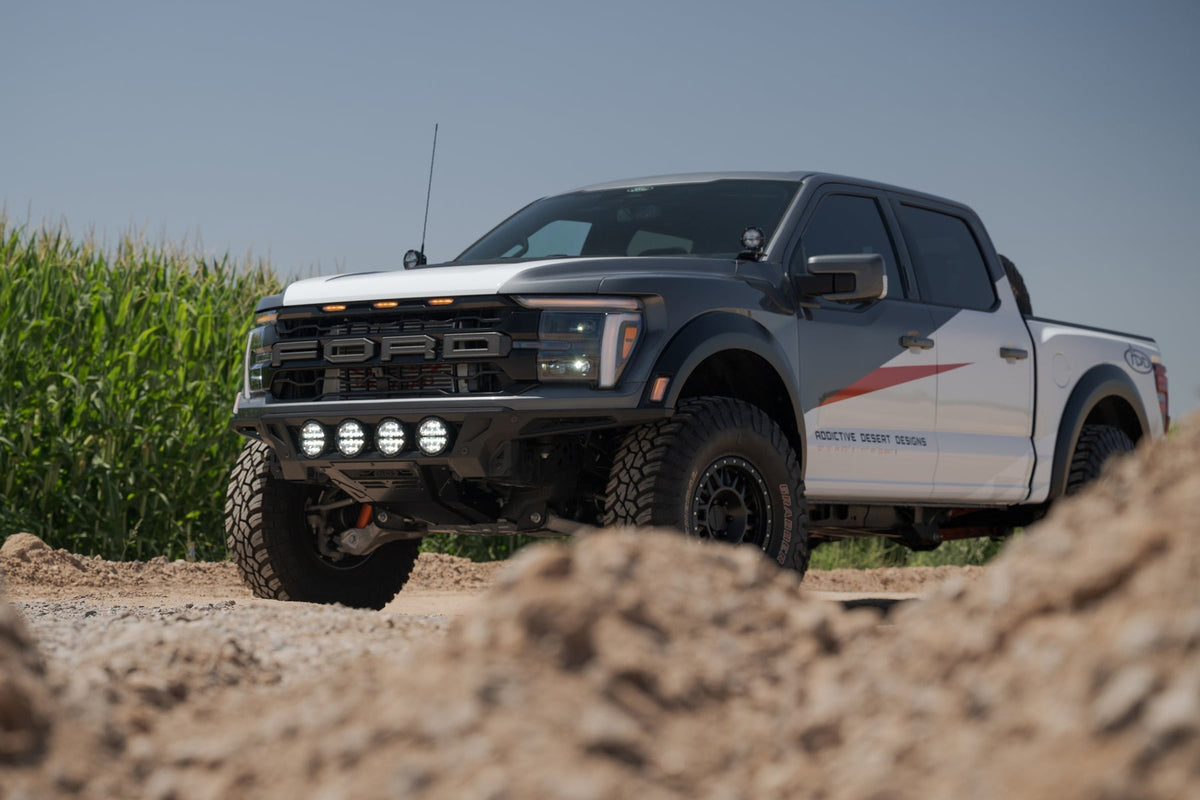
F-150 Overland Build Guide: What to Upgrade First, in Order
The F-150 makes a good overland truck for the same reasons it's a good work truck: a full frame, a real bed and payload to spend. The trap is spending it in the wrong order. This guide lays out an F-150 overland build in the order that makes sense, explains the trade-offs at each step, and flags where 13th-gen, 14th-gen and Raptor trucks need different parts.
Short answer: Build an F-150 for overlanding in this order: tires and recovery gear first, then armor such as bumpers and skids, then a leveling kit or lift, then lighting, then a bed rack or topper and storage, then power and air, and the interior last. Before each purchase, check the payload on the door-pillar placard and confirm the year, trim, cab and bed, because 2015 to 2020, 2021 to 2023, 2024 and newer, and Raptor trucks often take different parts.
What makes an F-150 an overland truck?
Overlanding is self-reliant travel, mostly on dirt and gravel, where the truck carries you and your camp for days at a time. It isn't rock crawling. Reliability, recovery and load matter more than articulation.
Every part should answer one of four questions: can the truck get there, can it get back, can it carry what you need, and can you live out of it. A part that answers none of them is decoration, and decoration costs payload.
First, confirm your generation, trim, cab and bed
F-150 parts are less interchangeable than people expect. Before you buy anything, write down the model year, trim and packages, engine, cab style and bed length.
| Truck | Years | Fitment notes from the parts we checked |
|---|---|---|
| 13th gen F-150 | 2015–2020 | Some front bumpers split again by year and engine: Fishbone's Pelican front winch bumper fits 2015–2017 and excludes Raptor and EcoBoost trucks. |
| 14th gen F-150 | 2021–2023 | Front bumpers are listed separately from 2024 and newer trucks. Adaptive cruise control usually needs a relocation bracket with an aftermarket bumper. |
| 14th gen F-150, updated | 2024 and newer | Its own front bumper fitment. ADD's 2024+ Stealth Fighter winch bumper excludes 2.7L EcoBoost and diesel trucks and needs extra work on 3.5L and PowerBoost trucks. |
| Tremor | 2021 and newer | Often excluded from standard suspension kits. ReadyLIFT sells Tremor-specific front lift kits. |
| Raptor | Both generations | Commonly excluded from standard F-150 bumpers and suspension. Shop Raptor-listed parts only. |
The Raptor exclusions are consistent across brands. DV8 lists its 2021–2023 MTO Series front bumper for all trims excluding Raptor, Fishbone says its 2015–2020 Pelican rear bumper does not fit the Raptor, and ICON says its 2021–2026 4WD coilovers won't fit the Tremor or the Raptor. Some interior parts cross over, like DV8's console MOLLE panels for 2015–2020 F-150 and 2017–2020 Raptor. Read the listing.
Cab and bed matter for racks and toppers: CBI sells separate F-150 racks for 6.5-foot and 5.5-foot beds. Exhaust matters for bumpers: DV8's MTO rear bumper is designed for single-exhaust trucks only.
Payload: the number that runs the whole build
Every F-150 has a Tire and Loading Information placard, usually on the driver's door pillar (the B-pillar). Federal rules require it to state the combined weight of occupants and cargo the truck should never exceed. That's your payload, and it's specific to your truck, so use the placard, not a brochure figure.
Remaining payload = placard payload − people − added parts − cargo − trailer tongue weight
Say a placard reads 1,500 lb (a made-up figure for the math). ADD lists its 2024+ Stealth Fighter winch front bumper at about 91,172 g, which is about 201 lb. Subtract that and you have 1,500 − 201 = 1,299 lb. Two 180 lb adults (also example figures) bring it to 1,299 − 360 = 939 lb, and you haven't added the winch, a rack, water, a cooler or camp gear yet. If you tow, the trailer's tongue weight counts too.
Weigh the plan before you buy it, choose the lighter part when two do the same job, and keep weight low and between the axles.
The F-150 overland build, in order
| Phase | What it includes | Why it comes here | Main trade-off |
|---|---|---|---|
| 1. Tires, wheels, recovery | All-terrain tires, recovery points, strap, soft shackles, traction boards | Tires decide where you can go; recovery gear decides whether you get home | Stiffer tires ride harder and add rotating weight |
| 2. Armor | Skid plates, front and rear bumpers, winch mount | Protects the parts that end a trip | Steel bumpers are heavy and sit at the ends of the truck |
| 3. Leveling or lift | Leveling kit, coilovers, full suspension system | Do it after you know the bumper and load weight | Alignment, ADAS recalibration and changed handling |
| 4. Lighting | Fog pocket lights, ditch lights, bumper bars | Bumper choice decides where lights can mount | Road-legal use varies; check your state's rules |
| 5. Bed rack, topper, storage | Bed rack or camper shell, boxes, water | This is where most payload goes | Height, weight and fit with a tonneau cover |
| 6. Power and air | Onboard air, power station or second battery | Size it once you know what you'll run | Wiring complexity and weight |
| 7. Interior | Seat covers, console MOLLE, device mounts, seat-delete storage | Comfort and organization once the truck works | Some mounts need drilling |
Phase 1: Tires, wheels and recovery gear
Tires decide where the truck can go, and they're the first thing to fail on sharp rock. A good all-terrain tire in a sturdy load range does more for an overland F-150 than any lift. ReadyLIFT points out a real cost here: aftermarket tires are often 10-ply E-rated, where factory tires are often 6-ply C-rated, and the stiffer sidewall reads as a harsher ride. Size tires to what your suspension supports without trimming unless you're ready to trim.
Buy recovery gear at the same time: rated frame-mounted recovery points, a recovery strap, rated shackles, traction boards, a shovel, gloves, and a tire deflator and gauge. Use only rated gear, never attach a strap to a tow ball, read the manufacturer's instructions before you need them, and keep everyone well clear of a line under load.
Phase 2: Armor, skids and bumpers
Look under the truck first. Many 4x4 trims and packages ship with some factory skid plates, so know what you have. Skids protect the parts that strand you: front differential, transfer case and fuel tank.
A steel front bumper gives you a winch mount, recovery points and light mounts, but adds weight at the very front. DV8's 2021–2023 MTO Series front bumper is listed at about 99 lb, handles up to a 12,000 lb winch and keeps the factory parking sensors. ADD's 2024+ Stealth Fighter winch bumper is listed at about 201 lb. That gap is worth weighing against your payload.
On 2021 and newer trucks with adaptive cruise control, plan on a relocation bracket. Both DV8 and ADD call for one with their bumpers on ACC-equipped trucks, and DV8's bracket excludes King Ranch and Platinum models and trucks with brush or nickel grilles. On 13th-gen trucks, check engine notes: Fishbone's 2015–2017 Pelican front winch bumper excludes EcoBoost trucks and says it has no provisions for an intercooler.
Phase 3: Leveling kit or lift
A leveling kit raises the front to remove the factory nose-down rake and make room for a slightly larger tire. A lift kit raises the whole truck and usually changes shocks, springs or control arms. For most overland F-150s, a level plus good shocks is enough.
- 2015–2020: ReadyLIFT's 2.25-inch leveling kit gives 2.25 inches through a strut extension. ReadyLIFT says it isn't for trucks that are factory leveled or have the off-road package, and lists a 35-inch maximum tire with trimming.
- 2021–2026: ReadyLIFT's 2.0-inch leveling kit fits most trims but not 2025–2026 Tremor models, and ReadyLIFT lists up to a 295/60-20 tire on a 20x9 +18 wheel with no trimming.
- Adjustable coilovers: ICON's V.S. 2.5 front coilovers for 2021–2026 4WD trucks adjust from 0 to 2.75 inches of lift on standard trucks, less on PowerBoost and diesel trucks, and ICON recommends 33x11.50 tires.
Do suspension after armor so ride height is set with the bumper and winch on. Budget for an alignment, and expect headlamp re-aim and ADAS recalibration, which ReadyLIFT and ICON both mention.
Phase 4: Lighting
Light the road close to the truck first. Fog lights with a sharp cutoff help in dust, rain and fog. Baja Designs says its Squadron SAE fog pocket kit for 2015–2020 F-150s is designed to meet SAE J583 fog lamp requirements and replaces halogen-style factory fog lights. Ditch lights on the A-pillar add side light for corners and trail edges. Morimoto, KC HiLiTES and Baja Designs all sell F-150-specific A-pillar or ditch light kits, listed by model year, so match the kit to your generation. Off-road-only lights stay off on public roads; check your state's rules.
Phase 5: Bed rack, topper and storage
This phase spends the most payload, so it comes after you know what everything else weighs. A bed rack keeps the bed open and gives you a platform for a rooftop tent, fuel or water cans and recovery boards. CBI's cab-height F-150 rack for 6.5-foot beds stands 20.5 inches above the bed rails, is built from 12-gauge steel, bolts together with no drilling and has a static load rating of about 900 lb.
A static rating is the load while parked, like a tent with people in it. A dynamic rating is the load while driving, and it's lower because bumps multiply the forces. CBI lists the static figure only, so ask before planning a heavy load on the road. A camper shell keeps gear dry and locked but adds weight and height; a rack leaves gear exposed.
Phase 6: Power and air
Size power to what you'll run, usually a fridge, lights and charging. A portable power station is simple and moves between vehicles; a second battery with a DC-DC charger is more permanent and takes more wiring. Onboard air lets you air down on dirt and air back up before pavement. Mount everything securely, fuse every circuit and follow the maker's wiring instructions.
Phase 7: Interior
Interior parts come last because they don't decide whether the truck gets there. DV8's center console MOLLE panels for 2015–2020 F-150s (and 2017–2020 Raptors) use AMPS hole spacing for device mounts and need drilling to install. Seat covers protect cloth or leather from mud and dogs. For storage inside the cab, browse our Goose Gear F-150 parts and check each listing's cab style before you order.
Mistakes to avoid
- Buying by "F-150" alone. Year, trim, engine, exhaust, cab and bed all change fitment, and Raptor parts usually differ.
- Ignoring the door placard. Add up the parts before you buy them, not after.
- Lifting before armor. A heavy bumper and winch change the front ride height you just set.
- Forgetting the driver aids. ACC relocation brackets, sensor cutouts and ADAS recalibration are part of the job on newer trucks.
- Treating a rack's static rating as a driving rating. Ask for the dynamic rating.
What NVMOS carries
We stock F-150 parts from Addictive Desert Designs, DV8 Offroad, Fishbone Offroad, ReadyLIFT, ICON Vehicle Dynamics, Baja Designs, Morimoto, KC HiLiTES, CBI Offroad Fab, Goose Gear and Tufskinz. A few representative parts, by generation:
- Fishbone Offroad Pelican Front Winch Bumper for 2015-2017 Ford F-150
- Fishbone Offroad Pelican Rear Bumper for 2015-2020 Ford F-150
- DV8 Offroad MTO Series Winch Front Bumper, 2021-2023 Ford F-150
- ADD 2024+ Ford F-150 Stealth Fighter Winch Front Bumper
- DV8 Offroad Adaptive Cruise Control Relocation Bracket, 2021-2026 Ford F-150
- ReadyLIFT 2.25" Leveling Kit, Ford F-150 2015-2020
- ReadyLIFT 2.0" Leveling Kit, Ford F-150 2021-2026
- ICON V.S. 2.5 Series Front Coilovers, 2021-2026 Ford F-150 4WD, 0-2.75" Lift
- Baja Designs Squadron SAE Fog Pocket Light Kit, 2015-20 F-150
- Morimoto Ford F-150 (21-26) 2Banger LED Ditch Light System
- CBI Ford F-150 Cab Height Bed Rack, 6.5' Bed, 2004-2022
- DV8 Offroad Center Console MOLLE Panels and Device Mount, 2015-2020 F-150
Browse everything for the Ford F-150, parts listed for the Ford F-150 Raptor, Goose Gear for the F-150, Tufskinz F-150 trim, bed racks and recovery gear. Check current lead times and each brand's warranty policy. In-stock parts ship in 24 to 48 hours.
Shop F-150 parts → Shop Raptor parts →
Frequently asked questions
What should I do first to build an F-150 for overlanding?
Start with tires and recovery gear. Good all-terrain tires and a rated recovery kit do more for an overland F-150 than a lift or lights, and they're what gets you home when something goes wrong.
Do regular F-150 parts fit a Raptor?
Usually not. Many standard F-150 bumpers and suspension kits exclude the Raptor, including DV8's 2021-2023 MTO front bumper and ICON's 2021-2026 4WD coilovers. Some interior parts list both. Always confirm the year, trim, cab and bed on the listing.
Is a leveling kit or a lift better for an overland F-150?
For most overland trucks, a leveling kit plus good shocks is enough. A full lift changes handling more and is worth it only if you need the clearance or a much bigger tire.
How much payload does an F-150 have for overlanding?
It depends on the exact truck. Check the Tire and Loading Information placard on the driver's door pillar, which states the combined weight of occupants and cargo the truck should never exceed. Subtract people, parts, cargo and any trailer tongue weight from that number.
Do I need an adaptive cruise control bracket for an aftermarket F-150 bumper?
On 2021 and newer trucks with adaptive cruise control, usually yes. DV8 and ADD both call for an ACC relocation bracket with their bumpers on equipped trucks. DV8's bracket excludes King Ranch and Platinum models and trucks with brush or nickel grilles.
Is a bed rack or a camper shell better for overlanding?
A bed rack keeps the bed open and carries a rooftop tent, cans and boards, but gear is exposed. A camper shell keeps gear dry and locked but adds weight and height. Count either against payload.
Not sure which parts fit your F-150 or what order makes sense for your trips? Call a real person at (920) 249-7744 or reach us through our contact page.
