





Toyota Tundra Overland Build Guide: What to Do, in Order
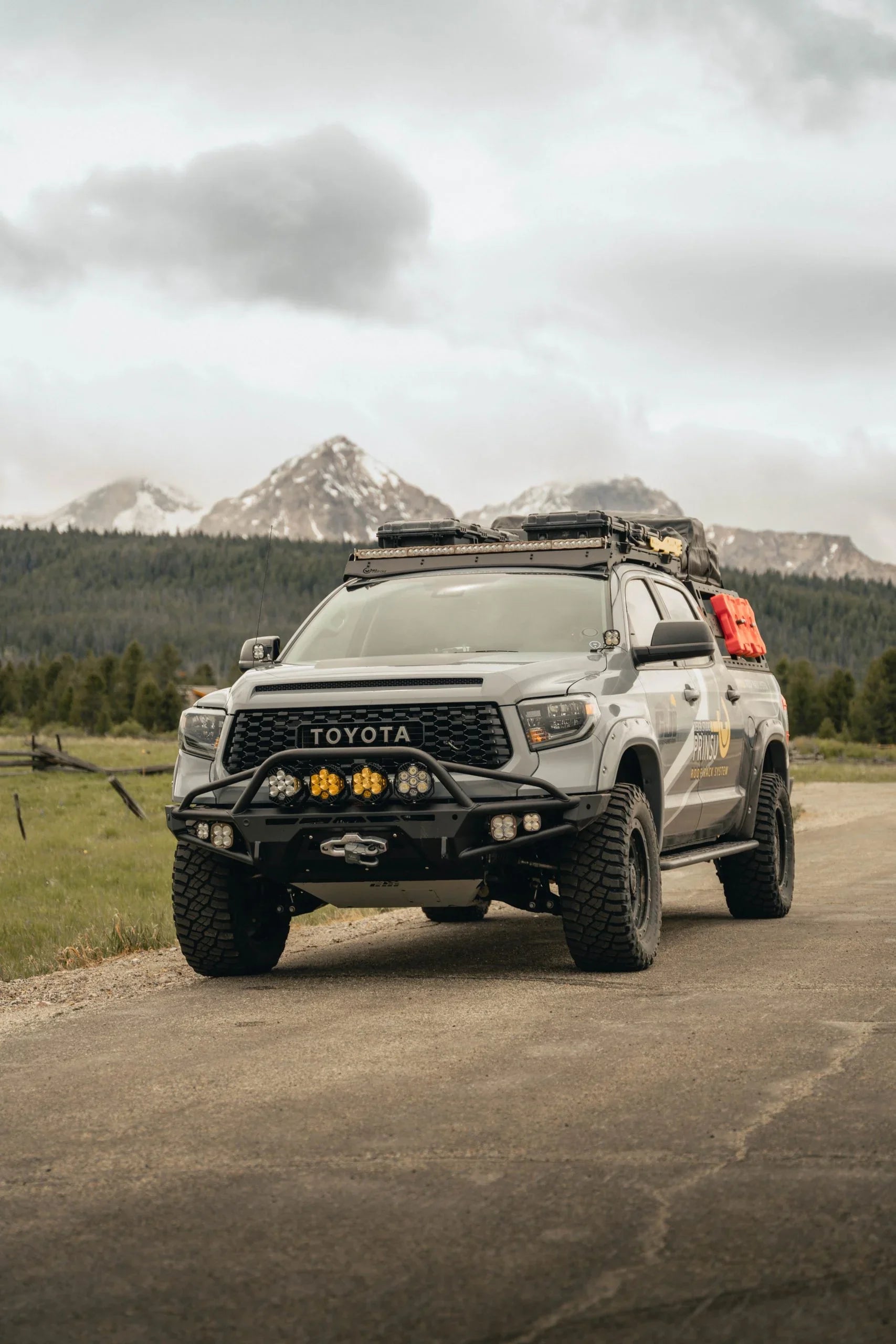
A Tundra makes a capable overland truck, and it's easy to spend money on it in the wrong order. Lights and racks are fun to buy; tires, recovery gear and armor get you home. This guide lays out the build in phases, explains the weight and payload trade-offs, and flags what changes between the 2nd gen (2007–2021) and the 3rd gen (2022 and newer).
Short answer: Build a Tundra for overlanding in this order: tires and recovery gear first, then armor (sliders and skid plates), then a leveling kit or lift, then lighting, then bed racks or a topper, then power and onboard air, and interior storage last. Every part adds weight that comes out of the payload printed on the door-jamb placard, so track it. Parts are generation-specific, so confirm model year, cab and bed length before you order anything.
First, know which Tundra you have
Almost nothing here fits every Tundra. Before you shop, write down model year, cab style and bed length.
- 2nd gen, 2007–2021. Rear leaf springs, and a 2014 refresh that changed the front end, bumpers and interior. Many parts, such as ditch light kits and headlights, come in separate 2007–2013 and 2014–2021 versions.
- 3rd gen, 2022 and newer. Toyota's press release for the 2022 Tundra describes a new boxed steel ladder frame and a multi-link rear suspension that uses coil springs instead of leaf springs, with rear air suspension available on certain grades. It offers a twin-turbo V6 and the i-FORCE MAX hybrid. Both matter for leveling kits.
Cab and bed matter just as much. Toyota lists Double Cab and CrewMax for the 3rd gen, with 5.5, 6.5 and 8.1 foot beds depending on cab. C4 Fabrication's Tundra sliders fit CrewMax only, and CBI's cab-height bed rack fits the short bed only. The wheel bolt pattern also changed between generations: BORA lists its Tundra spacers as 5x150 for 2007–2021 and 6x139.7 for 2022 and newer, so wheels and spacers don't carry over.
The build in phases
Each phase makes the next one safer or more useful. It isn't a law: if you never see a rock, move lighting up and armor down.
| Phase | What it includes | Why it comes here | Generation watch-outs |
|---|---|---|---|
| 1. Tires, wheels and recovery | All-terrain tires with a stronger sidewall, rated recovery points, traction boards, strap and shackles | Tires decide where the truck can go; recovery gear decides whether you get back | Bolt pattern differs; pick tire size with your planned lift in mind |
| 2. Armor | Rock sliders, front and control-arm skid plates, then bumpers | Protects the body and underside before you start driving harder trails | Sliders vary by cab; skids may limit diff drops |
| 3. Leveling kit or lift | Front leveling kit, or a full suspension system with new shocks | Clearance for bigger tires and a better ride with the weight you're adding | 3rd gen kits often exclude rear air or hybrid trucks |
| 4. Lighting | Ditch lights, fog replacements, then a light bar if you need it | Useful, but it doesn't keep you moving | A-pillar brackets are year-specific |
| 5. Bed and roof storage | Bed rack, topper or canopy, roof rack, MOLLE panels | Carries the gear, and the weight, of longer trips | Check bed length and cab style |
| 6. Power and air | Dual battery or power station, onboard compressor | Runs a fridge and lets you air up after airing down | Under-hood trays and mounts are generation-specific |
| 7. Interior | Device mounts, console storage, seat covers | Makes long days easier, but nothing here gets you unstuck | Dash and console shapes changed in 2022 |
Phase 1: tires, wheels and recovery gear
Tires matter most. An all-terrain or mud-terrain tire with a stronger sidewall resists punctures and lets you air down for traction. ReadyLIFT points out that larger aftermarket tires are often 10-ply rather than the factory 6-ply, which makes the ride feel stiffer.
Tire size is easy to work out from the sidewall:
Overall diameter (inches) = 2 × section width (mm) × aspect ratio ÷ 25.4 + rim diameter (inches)
A 285/70R17 works out to 2 × 285 × 0.70 ÷ 25.4 + 17 = about 32.7 inches. A taller tire also changes your speedometer. Going from a 32.7-inch tire to a 34.3-inch tire is about 4.7 percent larger, so when the speedometer reads 60 mph you're doing about 62.8. Pick tire size and lift together.
Recovery gear goes in with the tires. A basic kit is a set of traction boards, a recovery strap or kinetic rope rated for the truck's weight, rated soft or steel shackles, a tire deflator and gauge, and a way to air back up. Attach recovery gear only to rated recovery points, never to a tow ball or a tie-down loop, and follow the gear maker's instructions. Your owner's manual tells you which factory points are meant for recovery. For 3rd gen trucks, SXTH Element rates its bolt-on rear recovery points at 15,000 lb each in a straight-line pull and says they accept standard 3/4 inch shackles and soft shackles up to 1 inch wide.
Phase 2: armor before anything flashy
A Tundra is long, and its rocker panels are the first body parts to hit a ledge or rut. Frame-mounted rock sliders protect them. C4 Fabrication's sliders for both generations use a 3x2 inch rectangular main rail with 1-3/4 inch DOM tube, bolt on without drilling or dropping the fuel tank, fit CrewMax only, and sit at a flat 0 degree slope. C4 lists the 3rd gen version for CrewMax short beds. Raw finish has to be painted or powder coated before install.
Underneath, a front skid plate protects the front differential and the parts around it. CBI's 2014–2021 Front Overland Skid Plate is a bolt-on steel plate with drain ports. On 3rd gen trucks, the lower control arms hang low; DV8's 2022–2026 control-arm skids are 4.5 mm steel at about 19 lb and work with the factory TRD skid plate.
Bumpers come next. A steel front bumper with a winch is often the heaviest single part on the truck, and it sits ahead of the front axle. Buy one when you need a winch mount or better approach clearance. On newer trucks, read the listing for sensor and camera support.
Phase 3: leveling kit or lift
A leveling kit raises the front to match the rear, which gives room for a slightly larger tire and evens out the stance. A lift raises both ends, usually with new shocks or coilovers, and is the better choice once the truck carries real weight. Read every kit's exclusions before you buy:
- ReadyLIFT's 3-inch front leveling kit for 2007–2021 Tundras includes strut extensions with differential drop spacers, lists a 33-inch maximum tire (35 inches on positive-offset wheels with trimming), and is not for the TRD Pro.
- ReadyLIFT's 2-inch front leveling kit with diff drops for 2022 and newer Tundras says the drop improves the CV joints' operating angle. It is not compatible with factory rear air suspension or hybrid powertrains, and TRD Pro trucks need a separate skid plate drop kit.
- Both ReadyLIFT kits call for an alignment and a headlight re-aim, and say ADAS recalibration may be needed.
Phases interact. CBI says its 2014–2021 front skid accepts up to a 1-inch differential drop, and a leveling kit may include its own diff drop. Confirm they work together. If you plan a bigger build later, going straight to a complete suspension system avoids buying twice.
Phase 4: lighting, including ditch lights
Ditch lights mount at the base of the windshield and light the trail edges headlights miss. Morimoto's 2Banger ditch light system for 2014–2021 Tundras bolts on with no drilling and comes in flood, spot, combo and SAE wide patterns, in white or yellow. Morimoto says the wide and combo beams meet SAE standards when aimed correctly. For 2022 and newer, Baja Designs' XL Pro A-Pillar kit includes two XL Pro lights, brackets, a harness and spare spot and wide-cornering lenses. Keep spot beams off on public roads and check your state's rules for auxiliary lights.
Fog light replacements come next since they use factory mounts. A large light bar comes last, if at all.
Phase 5: bed racks, toppers and roof storage
This phase can add a lot of weight, and it sits high. A bed rack carries a rooftop tent, fuel or water, and traction boards over the bed while keeping the bed usable. CBI's cab-height bed rack is steel, covers 2007–2023 Tundras, fits the short bed only and requires drilling. A topper or canopy closes in the bed for secure storage and sometimes sleeping. A cab roof rack suits light, bulky gear. Keep heavy items low and between the axles, check each rack's load ratings, and count the rack's own weight against payload.
Phase 6: power and onboard air
A fridge and lights need power when the engine is off. On a 2nd gen, a dual battery system is one route. Genesis Offroad's Gen 3 Dual Battery System for 2007–2021 Tundras (Gen 3 is Genesis's version, not the truck's generation) uses two matching Group 25 batteries, says the factory battery isn't compatible, and warns that some 2014–2017 headlight assemblies may not fit.
Onboard air closes the loop on Phase 1: air down for the trail, air up for the highway. Rago Fabrication's Wifey Air System is a four-tire manifold with gauges for inflating or deflating all four tires at once. On Rago's own listing the compressor and mounts are sold separately, and Rago highly recommends professional installation. Check what a bundle includes before you order.
Phase 7: interior
Least urgent. Device mounts, console MOLLE panels and seat covers make long days easier, and they're generation-specific because the dash changed in 2022.
Weight and payload: the trade-off behind every phase
Payload is the hard limit. Find the Tire and Loading Information placard on the driver's door jamb. It lists the most combined weight of occupants and cargo your specific truck can carry. Use your placard, not a brochure figure.
Remaining payload = placard figure − occupants − everything you've added (parts, gear, water, fuel cans)
If a placard said 1,500 lb and two adults weighed 350 lb together, that leaves 1,500 − 350 = 1,150 lb for the bumper, sliders, rack, tent, fridge, water and everything else. Weigh the loaded truck at a public scale before a long trip.
Mistakes to avoid
- Buying by "Tundra" alone. Confirm year, cab and bed length. 2007–2013 and 2014–2021 parts often differ, and most 3rd gen parts don't fit 2nd gen trucks.
- Lights before tires and recovery gear.
- Ignoring kit exclusions. Rear air, hybrid and TRD Pro trucks can be excluded from 3rd gen leveling kits.
- Stacking parts that conflict. Diff drops and skid plates, bumpers and sensors, racks and toppers. Check each pair.
- Ignoring payload. Add up the weight first.
- Skipping the alignment and headlight re-aim after a lift or leveling kit.
What NVMOS carries
For Tundra builds we stock armor from C4 Fabrication, CBI Offroad Fab and DV8 Offroad; suspension from ReadyLIFT and ICON Vehicle Dynamics; lighting from Morimoto, Baja Designs and KC HiLiTES; storage and accessories from Rago Fabrication, Cali Raised LED and Goose Gear; power from Genesis Offroad; recovery points from SXTH Element; and trim from TufSkinz. Representative parts by phase:
- SXTH Element 2022+ Toyota Tundra Rear Recovery Points
- C4 Fabrication Tundra Rock Sliders, 2nd Gen, 2014-2021
- C4 Fabrication Tundra Rock Sliders, 3rd Gen, 2022+
- CBI Toyota Tundra Front Overland Skid Plate, 2014-2021
- DV8 Offroad 2022-2026 Toyota Tundra Front Lower Control Arm Skid Plates
- ReadyLIFT 3" Front Leveling Kit, Tundra TRD / SR5 / Rock Warrior 2007-2021
- ReadyLIFT 2" Front Leveling Kit With Diff Drops, Tundra 2022-2026
- Morimoto Toyota Tundra (14-21) 2Banger LED Ditch Light System
- Baja Designs XL Pro A-Pillar Light Kit, Tundra 2022-2026
- CBI Toyota Tundra Cab Height Bed Rack, 2007-2023
- Genesis Offroad 2007-2021 Toyota Tundra Gen 3 Dual Battery System
- Rago Fabrication 2014-2021 2nd Gen Tundra Wifey Air System Bundle
Browse all Toyota Tundra parts, Tundra lift kits, TufSkinz Tundra trim, recovery kits, bed racks and wheels and tires. See every brand we carry, check current lead times, and read each brand's terms on our vendor warranty policies page. In-stock parts ship in 24 to 48 hours.
Shop Tundra parts → Shop by vehicle →
Frequently asked questions
What should I upgrade first on a Tundra for overlanding?
Tires and recovery gear: all-terrain tires, traction boards, a rated strap, rated shackles and a way to air up. Armor comes next, then a leveling kit or lift.
Do 2nd gen Tundra parts fit a 3rd gen Tundra?
Usually not. The 3rd gen has a new frame, coil-spring rear suspension and a 6x139.7 bolt pattern instead of 5x150. Many 2nd gen parts are also split between 2007–2013 and 2014–2021.
Should I level or lift my Tundra for overlanding?
A leveling kit suits a modest tire and light loads. If the truck will carry a rack, tent, fridge and water, a full suspension system handles the weight better.
Can I put a leveling kit on a 3rd gen Tundra with rear air suspension or the hybrid?
Not every kit allows it. ReadyLIFT's 2-inch kit with diff drops for 2022 and newer Tundras excludes factory rear air suspension and hybrid powertrains.
How much weight can my Tundra carry?
Check the Tire and Loading Information placard on the driver's door jamb, then subtract passengers and every part and piece of gear you add.
Are ditch lights legal on a Tundra?
It depends on your state and the beam. Morimoto says its wide and combo beams meet SAE standards when aimed correctly; it makes no such claim for spot beams. Check your state's rules.
Do I need a bed rack or a topper for overlanding?
A bed rack carries a rooftop tent and gear above an open bed. A topper or canopy closes the bed for secure storage. Check fit for your bed length either way.
Do I need a dual battery system to run a fridge?
Not always. A dual battery system charges from the alternator and stays in the truck; a portable power station is simpler and moves between vehicles.
Not sure which parts fit your Tundra's year, cab and bed? Call a real person at (920) 249-7744 or reach us through our contact page.
