





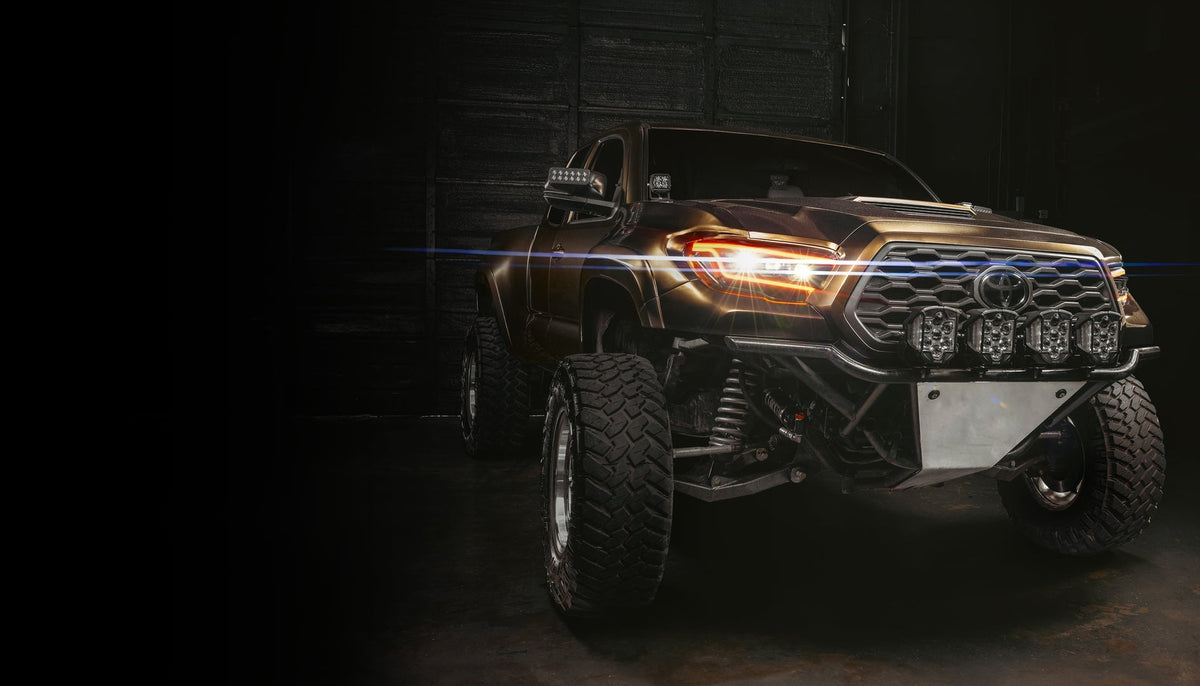
Ditch Lights Guide: Spot vs Flood Lights, Color and Mounting
Ditch lights are the small pods bolted near the base of the windshield, and they solve a problem your headlights were never designed for: seeing what is beside the truck, not just in front of it. Choosing a set comes down to beam pattern, color, and kit versus pods and brackets. This guide explains spot vs flood lights in plain terms and covers the wiring and aiming mistakes that make good lights look bad.
Short answer: Ditch lights are auxiliary LED pods mounted at the A-pillar or hood hinge to light the edges of the trail, the shoulder and the inside of turns. For that job, a wide, flood or combo beam usually works better than a spot, because a spot throws a narrow beam far ahead and leaves the sides dark. Choose white for the most usable light, amber or selective yellow if you drive in dust, snow or fog a lot, and treat them as off-road lights unless your state says otherwise.
What are ditch lights?
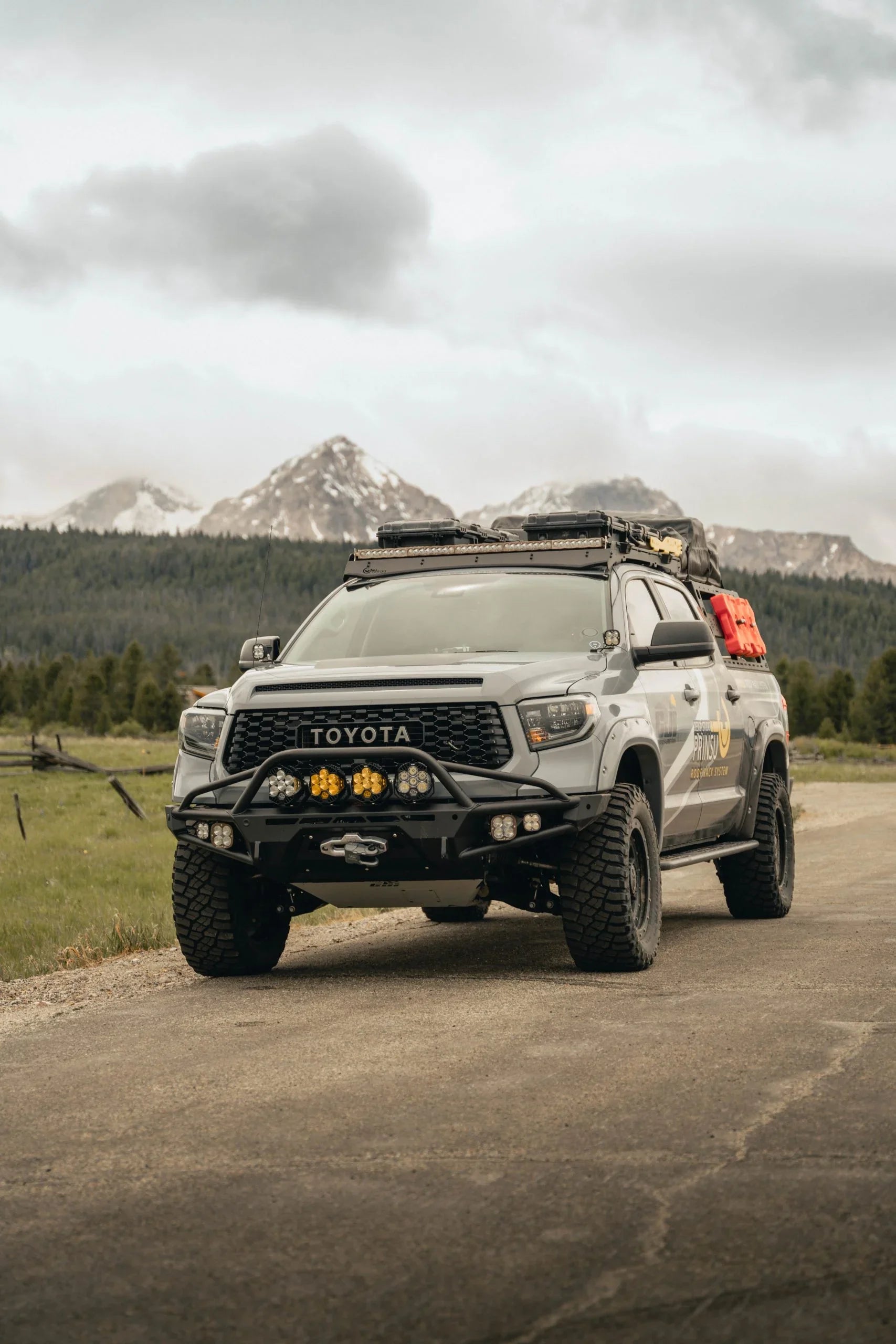
A ditch light is any auxiliary light mounted low on the windshield frame, usually one per side, on a bracket that bolts to the A-pillar, the hood hinge or the cowl. The name comes from what they light up: the ditch, the shoulder and the rut you are about to drop a wheel into. Headlights are aimed down and forward to avoid blinding other drivers. Ditch lights fill the space they leave out, especially to the sides and around corners. Knuckle-mounted pods take that a step further by turning with the front wheels; see our knuckle pod lights guide.
Why that location? A few practical reasons:
- Height and width. Mounted at the outer corners of the cowl, the lights sit wide apart and above the headlights, so they can be angled outward to cover the edges of the trail.
- Solid mounting points. The hood hinge bolts and A-pillar are rigid structure on most trucks and SUVs, which helps keep the lights from shaking on washboard roads.
- Out of harm's way. Up at the windshield, the pods are away from rocks, brush and stuck-in-the-mud splash that a bumper-mounted light takes head on.
The trade-off is the hood. Lights that sit near or behind its leading edge can bounce glare back into your eyes.
Spot vs flood lights: beam patterns explained
Every LED pod uses a reflector, a lens or both to shape its light, and the shape matters more than raw output. The patterns you will see across brands:
- Spot: a narrow, concentrated beam for distance. Baja Designs specifies its S2 spot optic at about 9 degrees.
- Flood: a broad, even spread of light at shorter range. Morimoto describes its flood beam as built for scene lighting.
- Wide or driving: stretched horizontally, with more reach than a flood. Baja calls theirs wide cornering, a flattened 42-degree beam meant to reduce blind spots in turns.
- Combo: spot and wider optics in one housing. Baja's driving/combo pairs 9-degree and 42-degree optics.
- SAE fog: a wide, low beam with a sharp top cut-off, built to a road-use fog standard. KC HiLiTES lists its FLEX ERA 3 Dual Mode under the SAE J583 fog beam.
| Beam | Shape | Best at | Weak at | As a ditch light |
|---|---|---|---|---|
| Spot | Narrow, long | Distance on straight, open roads | Sides, corners, close range | Only if you have no other distance light |
| Flood | Broad, even, short | Slow trails, camp, work areas | Reach at speed | Good for tight, slow trails |
| Wide / driving | Flat and wide, medium reach | Shoulders, turns, peripheral vision | Long-distance throw | The most common pick |
| Combo | Spot center with wider spill | One light that does a bit of everything | Neither the farthest nor the widest | Solid choice if these are your only aux lights |
| SAE fog | Wide, low, sharp cut-off | Fog, snow, rain, dust close to the vehicle | Distance | Useful for bad-weather driving |
Why beam angle matters more than lumens
A little geometry shows the difference. For a cone of light with a full beam angle θ, the width of the lit patch at distance d is roughly width = 2 × d × tan(θ ÷ 2). At 100 feet, a 9-degree spot covers a strip about 15.7 feet wide. A 42-degree wide beam covers about 76.8 feet. Real beams have soft edges, so treat those numbers as a rough guide, but the point stands: the spot puts its light into a patch about one fifth as wide.
The other half of the story is distance. Light on the ground falls off with the square of distance (illuminance = intensity ÷ distance²), so doubling the distance leaves a quarter of the light per square foot. That is why a spot, which packs its output into a narrow cone, reaches farther. Ditch lights work close in, where a wider beam spends its light where you need it.
Which beam should you run as ditch lights?
Start with what else is on the truck. If you already have a light bar or bumper pods with spot optics, your ditch lights should cover the sides, so pick wide, driving or flood. If the ditch lights are your only auxiliary lights, a combo gives you some distance without giving up the edges.
Speed matters too. On tight, slow trails, a flood shows rocks and roots beside the fenders. On faster gravel roads, a wide or driving beam reaches the road edge before you do.
White vs amber or selective yellow
Most pods come in clear (white) or with an amber or selective yellow lens. Some, like the KC FLEX ERA 3 Dual Mode, ship with clear lenses installed and selective yellow lenses in the box, so you can switch with the season. Baja Designs offers clear, Baja Amber and factory amber lenses on its S2 line. The trade-offs are well known:
- White gives the most usable output from a given light and shows colors and terrain detail most naturally. It is the default for clear nights.
- Amber or selective yellow is popular for dust, snow, rain and fog because many drivers find it reflects less glare back off the particles in the air and is easier on the eyes over a long drive. A colored lens filters some light, so expect less raw output than the same light with a clear lens.
A common setup is white for distance and amber in the ditch or fog positions. Neither color makes fog go away; slowing down still does more than any lens.
Vehicle-specific kits vs universal pods and brackets
You can buy ditch lights two ways. A vehicle-specific kit bundles pods, brackets built for your truck and usually wiring. Morimoto sells 2Banger, 4Banger and BigBanger ditch light systems with application-specific brackets for the A-pillar or cowl, and Baja Designs offers Squadron Pro A-pillar kits with brackets, a toggle switch harness and three lens options. The other way is to buy pods you like and pair them with a bracket from a fabricator such as Rago Fabrication, CBI Offroad Fab, Addictive Desert Designs or DV8 Offroad.
| Vehicle-specific kit | Universal pods + brackets | |
|---|---|---|
| Fit | Designed for one platform | Depends on the bracket; check bolt pattern |
| Ordering | One part number, fewer surprises | Pods, brackets and wiring bought separately |
| Choice | Limited to what the kit offers | Any pod size, brand, beam or color |
| Wiring | Often included; confirm per kit | Usually a separate harness and switch |
| Best for | Fast, clean install on a popular platform | Matching existing lights or odd vehicles |
If you go universal, check two things before ordering: that the bracket's mounting hole matches your pod's base (single bolt, dual bolt or a cube-style mount), and that the bracket puts the light high enough to clear the hood line.
Wiring basics: relay, switch and fuse
Most pod lights wire up the same way, and a proper harness does most of the work:
- Fuse near the battery, on the power lead, to protect the wire if it ever shorts. Use the fuse rating the harness or light maker specifies.
- Relay that carries the lights' current, so the switch in the cab only handles a tiny control signal.
- Switch in reach of the driver, ideally lit so you can tell when the lights are on.
To get a feel for the load, current is roughly power divided by voltage (amps = watts ÷ volts). Baja Designs lists the Squadron Pro at 65 watts per light, so a pair draws about 9.6 amps at a running voltage around 13.5 volts. KC lists the FLEX ERA 3 Dual Mode at 35 or 55 watts per light depending on mode, about 8.1 amps for a pair at the higher setting. That current belongs on a relay, not a dash switch.
Disconnect the battery before you start. Route wires through an existing firewall grommet, keep them away from exhaust and moving parts, and leave slack at the hood hinge so opening the hood never pulls on the harness. Follow the light maker's instructions, and if you are not comfortable with 12-volt wiring, have a shop do it.
Are ditch lights legal?
Most ditch lights are sold for off-road use, and rules for auxiliary lights on public roads vary from state to state, including how many forward lights you can run, how high they can be mounted and whether they must be covered on the street. Lights built to an SAE fog standard are designed for road use in bad weather, but that does not settle every question. Check your state's rules before using any auxiliary light on the road, and turn them off for oncoming traffic.
Common ditch light mistakes
- Glare off the hood. If the pods sit low or far back, part of the beam hits the hood and reflects into your eyes. Raise them with a taller bracket or extension, move them forward, or aim them up and out until the hood is dark from the driver's seat.
- Bad aim. Aim at night on level ground. Point each light slightly outward toward its own side and keep the hot spot low enough to light the ground, not the treetops. Snug the bolts, drive a few miles, and check again.
- Spot beams in the ditch position. They light a narrow strip far ahead and leave the sides dark.
- Skipping the relay. Wiring lights straight to a switch overloads it. Use a harness with a relay and fuse.
- Flimsy brackets. Pods that vibrate blur the beam and loosen hardware.
- Chafed wires at the hinge. Wire pinched by the hood or rubbing on sheet metal eventually shorts. Leave slack and use loom.
What NVMOS carries
We carry auxiliary lighting from Morimoto, Baja Designs, KC HiLiTES, ORACLE Lighting, Cali Raised LED and DV8 Offroad, plus vehicle-specific ditch light brackets and mounts from Rago Fabrication, CBI Offroad Fab, Addictive Desert Designs, Artec Industries and CMM Offroad. A few places to start:
- Morimoto 2Banger LED Ditch Light System for the 2016–2023 Toyota Tacoma
- Morimoto 2Banger LED Ditch Light System for the 2014–2024 Toyota 4Runner
- Morimoto 2Banger LED Ditch Light System for the 2021–2026 Ford F-150
- Morimoto 2Banger LED Ditch Light System for the 2019–2024 Ram 1500
- Baja Designs Squadron 2.0 Pro A-Pillar Light Kit for the Jeep Wrangler JL and Gladiator JT
- Baja Designs Squadron 2.0 Pro A-Pillar Light Kit for the 2019–2026 Chevy Silverado 1500
- KC HiLiTES FLEX ERA 3 LED 3.5-inch SAE Fog 2-Light Master Kit, with clear and selective yellow lenses, a harness and a switch.
- ORACLE Lighting 2015–2023 Ford F-150 A-Pillar Hood Mount Brackets with VEGA Series 2 Spotlights
- Cali Raised LED Ditch Light Mount Kit for the 2021+ Ford Bronco
- CBI Offroad Fab 5th Gen Toyota 4Runner Ditch Light Brackets
- Rago Fabrication 2022+ Toyota Tundra Ditch Light Brackets
- CMM Offroad Universal A-Pillar Ball Mount
Browse by category: Fog & Ditch Lights, Fog & Ditch Light Mounts, LED Light Pods & Cube Lights, Light Wiring & Harnesses and Switches. You can also shop by vehicle, check current lead times and read the vendor warranty policies.
Shop fog and ditch lights → Shop ditch light brackets →
Frequently asked questions
What are ditch lights on a truck?
Ditch lights are auxiliary LED pods mounted at the base of the windshield, on the A-pillar, hood hinge or cowl. They light the sides of the road or trail, the shoulder and the inside of turns, which headlights leave mostly dark.
Should ditch lights be spot or flood?
For most people, neither extreme. A wide, driving or flood beam suits the ditch position because the job is lighting the sides. Choose combo if the ditch lights are your only auxiliary lights, and save spot beams for a light bar or bumper.
What is the difference between spot and flood lights?
A spot concentrates its output in a narrow beam that reaches far ahead. A flood spreads it wide and even at shorter range, which suits slow trails and camp.
Are amber ditch lights better than white?
It depends on conditions. White gives the most usable light and natural color on clear nights. Many drivers prefer amber or selective yellow in dust, snow, rain and fog because it reflects less glare back at them, though a colored lens costs some output.
Are ditch lights legal to use on the road?
Most ditch lights are sold for off-road use, and auxiliary light rules vary by state. Check your state's rules before using them on public roads, and always turn them off for oncoming traffic.
Do ditch lights need a relay?
Yes. A relay lets the switch control the lights with a small signal while the relay carries the full current. Use a harness with a relay, an inline fuse near the battery and a switch, and follow the light maker's instructions.
How do I stop ditch lights from reflecting off the hood?
Raise the pods with a taller bracket or extension, move them forward of the hood line, or aim them up and outward until the hood looks dark from the driver's seat.
Can I use any pod light as a ditch light?
Usually, as long as the bracket matches the pod's mount and puts it high enough to clear the hood. Vehicle-specific kits remove the guesswork.
Not sure which beam, color or bracket fits your build? Call a real person at (920) 249-7744 or send us a message, and we will help you sort it out.
