





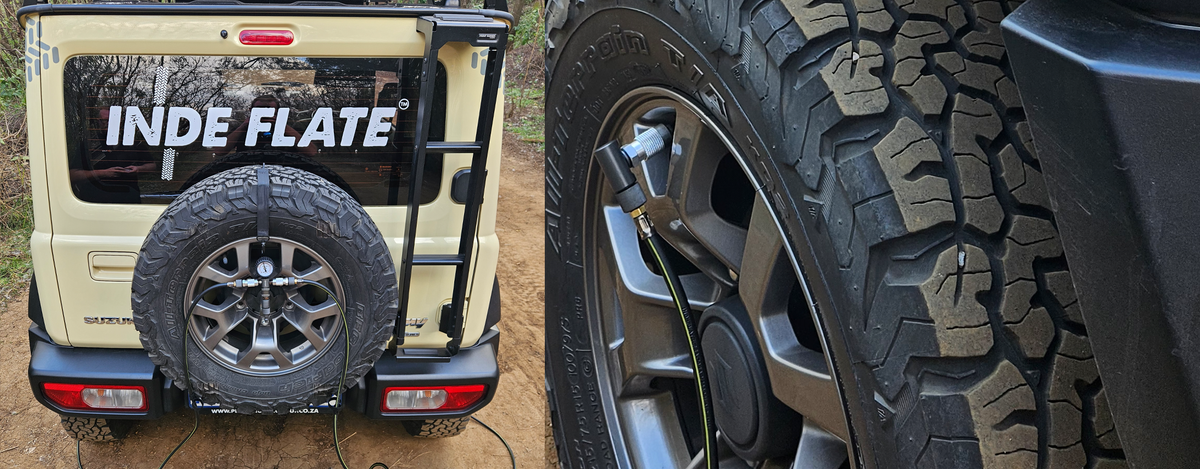
Airing Down: Tire Deflators, Onboard Air and How Much PSI
Letting some air out of your tires before a trail makes the vehicle grip better, ride softer and shrug off sharp rocks more easily. It also makes the tires easier to damage and the vehicle worse on pavement, so the job isn't finished until you've aired back up. This guide covers why and how much to air down, which tire deflator style fits the way you wheel, how onboard air compares with a portable compressor or CO2, and the basics of duty cycle, tanks, wiring, mounting and maintenance.
Short answer: How much to air down depends on your tires, wheels, load and terrain, so there is no single correct number. As a general starting point, drivers on standard wheels often drop about 20% from street pressure for gravel, about 30% for rocky trails and about 40% for sand, then adjust a few PSI at a time. Follow your tire and vehicle maker's guidance, drive slowly while aired down, and air back up before highway speeds.
What does airing down actually do?
A tire at lower pressure flattens out where it meets the ground. The contact patch gets longer, the tread wraps over rocks and ledges instead of balancing on them, and the sidewall soaks up impacts that would otherwise go straight into the suspension. Jeep Jamboree USA's driving guide, for example, describes airing down as giving a smoother ride off-highway and a larger footprint for better traction over rocks and loose ground.
- Traction: a longer, more flexible footprint puts more rubber on the surface. In sand it also spreads the load so the tire floats instead of digging.
- Ride: a softer tire acts like extra suspension on washboard and rock, which is easier on the vehicle, the cargo and the people inside.
- Puncture resistance: a hard tire meets a sharp rock with the full force of its pressure. A softer tire flexes around it, which lowers the chance of a tread puncture.
The trade-offs
Every benefit above has a cost.
- Sidewall damage: the sidewall bulges out further at low pressure, so it's more exposed to sharp rocks and more likely to be pinched.
- Bead problems: on standard wheels, air pressure is what holds the tire bead against the rim. Too little and a hard sideways load can push the bead off, dumping all the air at once. Jeep Jamboree USA's guide warns about exactly this.
- Heat: a soft tire flexes more with every rotation, and flexing builds heat. That's harmless at trail speed and a real problem at highway speed.
- Ground clearance: a flatter tire sits lower, so you give up some clearance under the axles.
- On-road handling: steering and braking suffer on pavement.
How much to air down: starting points by terrain
The figures below are general starting points for tires on standard (non-beadlock) wheels, expressed as a percentage off your normal street pressure. They are roughly in line with common off-road guidance, but they are not a recommendation for your specific tire. Load range, sidewall construction, vehicle weight and what you're carrying all change the right number, so check your tire and vehicle maker's advice first.
| Terrain | Starting point | From 35 PSI | From 40 PSI |
|---|---|---|---|
| Gravel and washboard | About 20% lower | 28 PSI | 32 PSI |
| Rocky trails | About 30% lower | 24.5 PSI | 28 PSI |
| Mud and snow | Start near the rocky-trail figure and adjust | About 24–25 PSI | About 28 PSI |
| Soft sand | About 40% lower | 21 PSI | 24 PSI |
The math is simple: trail pressure = street pressure × (1 − percentage). For a tire you normally run at 40 PSI, 40 × (1 − 0.30) = 28 PSI as a rocky-trail starting point.
From there, adjust gradually. Drop two or three PSI at a time, drive a bit, and watch how the tire behaves. If the sidewall looks badly folded, the tire squirms in turns, or you start hitting things under the axles, add air back. Heavier vehicles and heavily loaded rigs generally need to stay at the higher end.
Beadlocks vs standard wheels
A beadlock wheel clamps the tire's outer bead mechanically, so the bead stays put at pressures that would let a standard wheel lose it. That's why rock crawlers on beadlocks run far lower than anything in the table above. Beadlocks don't make the sidewall tougher, though, and they need their bolts checked and torqued to the maker's spec. Some states restrict beadlocks on public roads, so check your state's rules. On standard wheels, stay conservative. Losing a bead on the trail means re-seating it, which takes a lot of air quickly and isn't always possible.
Air back up before you drive at speed
This is the part people skip, and it's the part that matters most. A tire aired down for the trail flexes hard and builds heat at road speed, and heat is what breaks tires down. Jeep Jamboree USA's guide puts it plainly: always air up when returning to paved roads, and never air down without a way to air back up.
Keep speeds low while aired down. If you have a long gravel or pavement stretch between trail sections, air up for it. Then use an accurate gauge to bring every tire back to the pressure on your door placard or the one your tire maker specifies for your load.
Types of tire deflators
A tire deflator is any tool that lets air out faster and more precisely than pressing a valve core with a key. There are three main styles.
| Type | How it works | Good for | Trade-off |
|---|---|---|---|
| Manual gauge deflator | Attaches to one valve; you open a bleed valve and watch the gauge | Anyone; changing targets on the fly | One tire at a time, and you have to watch it |
| Automatic preset deflators | Set to a pressure, installed on each wheel, they stop venting at the preset | Fast, repeatable air-downs | Changing the target takes resetting each one; verify with a gauge |
| Multi-tire systems | Hoses to two or four tires from one central unit with a gauge | Equal pressure across tires; inflating and deflating together | More hose to manage and store |
Whatever you choose, a separate, reliable gauge is worth having so you can cross-check. Gauges disagree, and a few PSI matters when you're already low.
Onboard air vs portable compressor vs CO2
Airing down takes minutes. Airing up is the slow part, and your air source decides how slow.
| Air source | Strengths | Limits |
|---|---|---|
| Onboard compressor | Always on the vehicle, hard-wired, can run air lockers and air tools with the right accessories | Installation, wiring and a mounting spot; tied to one vehicle |
| Portable compressor | Moves between vehicles, no permanent install | Takes storage space, needs clamping to the battery each time, often less output |
| CO2 system | Silent, no electrical draw, fast | Finite supply, so the tank needs refilling; plan how many air-ups a fill covers |
When comparing compressors, look at flow at pressure, not just at 0 PSI. ARB, for instance, lists its CKMTA12 twin compressor at 6.16 CFM at 0 PSI and 4.68 CFM at 29 PSI. The second number is closer to what you get while filling tires.
Duty cycle and air tank basics
Duty cycle is the share of time a compressor can run before it needs to rest and cool. The formula is run time = duty cycle × period. ReadyLIFT, for example, rates its LOGIQ AirIQ SD compressor at a 25% duty cycle, which it describes as 15 minutes per hour (0.25 × 60 = 15). ARB lists the CKMTA12 at a 100% duty cycle. Makers test under their own conditions, so compare duty cycles within each maker's published specs rather than treating them as directly equivalent. If you run a compressor past its duty cycle, you shorten its life.
An air tank stores compressed air so you get a burst of flow bigger than the compressor alone can give, which helps with air tools and with re-seating a bead. The rough amount of air a tank delivers is free air ≈ tank volume × (starting PSI − ending PSI) ÷ 14.7, with pressures as gauge readings. A 2-gallon tank drawn from 150 down to 100 PSI gives about 2 × 50 ÷ 14.7 ≈ 6.8 gallons of air at atmospheric pressure. That helps with a top-up or a tool, but the compressor still does most of the work filling four tires. Never exceed a tank's rated pressure. ReadyLIFT rates its LOGIQ 2-gallon tank to 200 PSI.
Wiring and mounting basics
Treat this as an overview, not installation instructions. Follow the maker's manual, and if you're not comfortable with high-current wiring, have a qualified installer do it.
- Respect the current draw. Onboard compressors pull serious amperage. ARB lists the CKMTA12 at up to 68.6 amps. Use the maker's harness, fuse and relay, and the wire gauge it specifies.
- Run the engine while you air up. A big compressor can flatten a battery quickly if the alternator isn't helping.
- Mount it where it can breathe. Compressors make heat. Pick a location with airflow, away from exhaust heat, and protected from direct water and mud. ARB rates the CKMTA12 at IP55 for dust and water resistance, which is not the same as submersible.
- Mount it solidly. Use a bracket made for your compressor and vehicle so it isn't stressing fittings or rattling loose.
- Put the chuck somewhere convenient. A coupler near the bumper or in the bed saves dragging hose through the engine bay.
Maintenance
- Check and replace the compressor's intake filter per the maker's schedule, more often in dust.
- Spray fittings with soapy water to find leaks. A slow leak keeps the compressor cycling.
- Drain moisture from air tanks as the maker directs.
- Keep deflators and couplers clean and capped. Grit in a valve or preset deflator causes leaks and wrong readings.
- Inspect hoses for cracks and chafing, and check electrical connections for corrosion.
Common mistakes to avoid
- Airing down with no way to air back up, or driving at highway speed while aired down.
- Copying someone else's pressure without considering your tires, wheels and load.
- Going too low on standard wheels and losing a bead.
- Running a compressor past its duty cycle, or wiring it with undersized wire or no fuse.
What NVMOS carries
We stock deflators, onboard compressors, air management and the brackets to mount them. Brands include Indeflate, ARB, ReadyLIFT, TeraFlex, Method Race Wheels, Rago Fabrication, Fishbone Offroad and DV8 Offroad.
- Multi-tire inflate and deflate: Indeflate, made in South Africa, handles two or four tires at once, both deflating and inflating from your air source, and balances pressure between connected tires. The Digital Editions use a 100 PSI (700 kPa) digital gauge. See the Indeflate Four Hose Unit Digital Edition and the Indeflate Two Hose Unit Digital Edition.
- Preset deflators: the TeraFlex Universal Tire Deflator Kit is a set of four wheel-mounted deflators that adjust between 8 and 28 PSI, work with a twist and no tools, and are TPMS compatible, according to TeraFlex.
- Manual gauge deflator: the Method Air Deflator Gauge pairs a brass deflator with a 0–60 PSI dial gauge. Method notes it doesn't fit its 101 and 103 beadlock wheels because of where their valve stems sit.
- Onboard compressors: the ARB Twin Air Compressor (CKMTA12) and ARB Single Air Compressor (CKMA12), plus vehicle-specific kits such as the Rago 3rd Gen Tacoma Wifey Air System Bundle.
- Mounts: the DV8 Bronco Air Compressor Mount and Storage Box and the Fishbone Offroad JL Rear Trunk Compressor Mount.
- Load-leveling air: ReadyLIFT's LOGIQ AirIQ packages are a different job. They manage air springs for load leveling, with app control and saved presets, and the air springs are sold separately. See the ReadyLIFT LOGIQ AirIQ HD2 Air Management Package and the matching LOGIQ 2-gal Air Tank, which ReadyLIFT sells as a boost tank for AirIQ.
Browse On-Board Air Systems, On-Board Air Compressors, CO₂ Air Systems and Tire Accessories. For vehicle-specific mounts, start at Shop by Vehicle, and check current lead times before a trip. Warranty details for each brand are on our vendor warranty policies page.
Shop on-board air → Shop Indeflate →
Frequently asked questions
How much should I air down my tires for off-roading?
There's no single correct number. As a general starting point on standard wheels, many drivers drop about 20% from street pressure for gravel, about 30% for rocky trails and about 40% for sand, then adjust a few PSI at a time. Follow your tire and vehicle maker's guidance, and stay higher with heavy loads.
Is it safe to drive on the highway with aired-down tires?
No. Low pressure at road speed makes the tire flex and overheat, and handling and braking suffer. Air back up to your normal pressure before driving at highway speed.
How does a tire deflator work?
It lets air out of the valve faster and more precisely than pressing the valve core. Manual deflators have a bleed valve and gauge, preset deflators stop venting at a set pressure, and multi-tire systems like Indeflate connect several tires to one unit and gauge.
Are automatic tire deflators accurate?
Good preset deflators are repeatable, and TeraFlex says its kit stays consistently accurate once set. Still, check the final pressure with a reliable gauge, especially the first few times you use them.
Do I need onboard air or is a portable compressor enough?
A portable compressor works if you air down occasionally or move it between vehicles. Onboard air makes sense if you air down often, run air lockers, or want air available without setup every time.
What does compressor duty cycle mean?
It's the share of time a compressor can run before it needs to cool. A 25% duty cycle means 15 minutes of running per hour. Higher duty cycles suit bigger tires and frequent air-ups.
Can I air down on non-beadlock wheels?
Yes, but stay conservative. Standard wheels rely on air pressure to hold the bead, so going too low risks the tire coming off the rim under sideways loads. Beadlocks allow lower pressures, but check your state's rules on using them on public roads.
Questions about which deflator, compressor or mount fits your rig? Call a real person at (920) 249-7744 or reach us through our contact page.
